

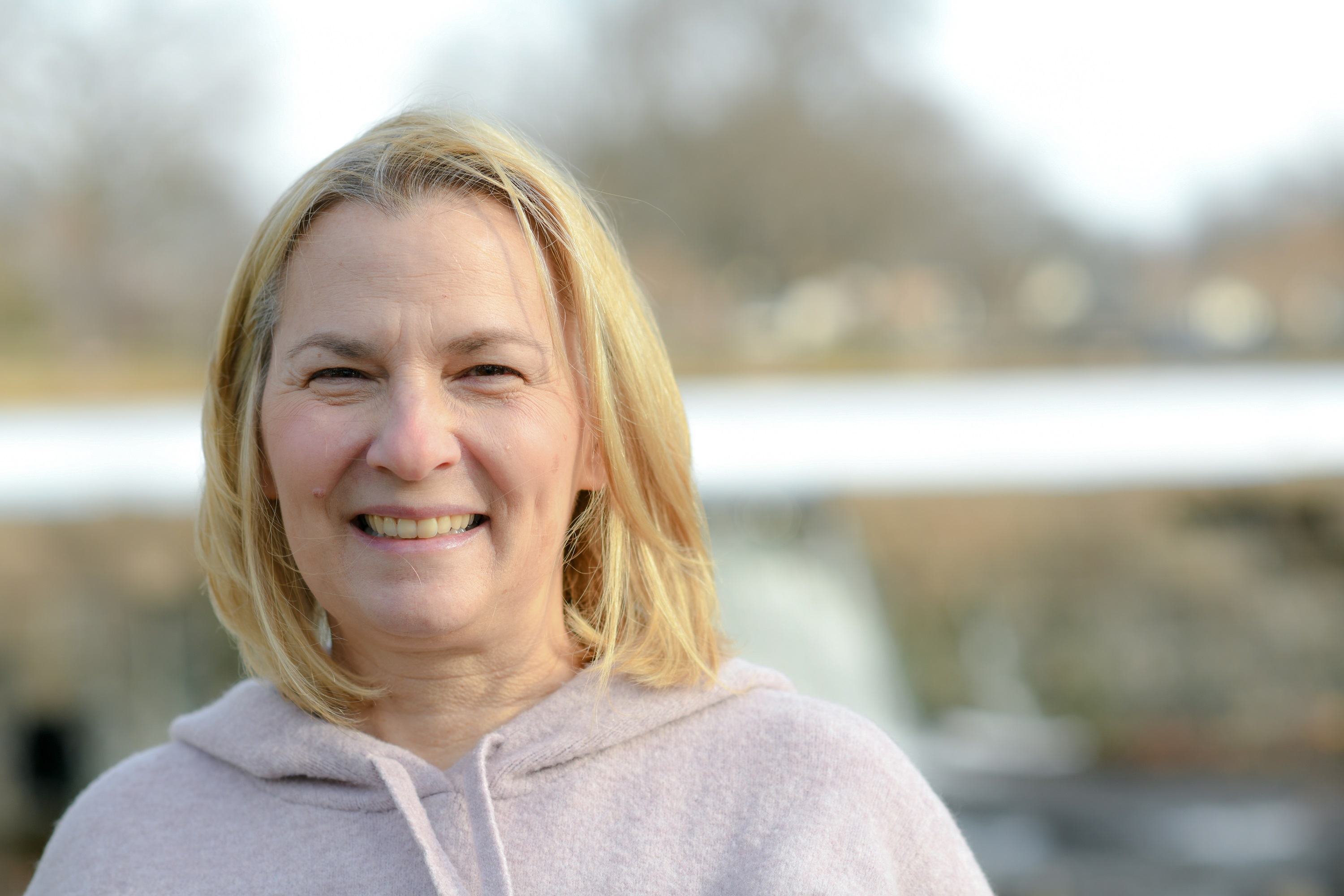
In September 2019, 54-year-old Julie Van Tine got home from a regular day at work in office administration, spent her evening as she normally would and went to bed feeling fine. The Hawthorne, New Jersey, resident woke up in the middle of the night and realized she couldn’t move her right side or, worse, talk at all.
“I tried to wake my husband, but I couldn’t say anything,” she remembers.
While she couldn’t form words, she was still able to make sounds. Her crying woke her husband, who hustled her into the car and drove her to the emergency room at Hackensack University Medical Center.
She arrived at the hospital unable to speak, swallow or understand what the medical staff said to her, says neurologist Martin Gizzi, M.D., Ph.D. A CT scan clearly showed a small clot that was impacting the speech area of the left hemisphere of Julie’s brain.
Common Issue With Uncommon Consequences
By the time Julie arrived at the hospital, it was already too late for clot-busting drugs to be administered. What wasn’t obvious was what had caused her stroke.
Julie didn’t have any of the usual risk factors for stroke, such as diabetes, hypertension or high cholesterol, and she had no family history of stroke. Advanced cardiac imaging allowed Dr. Gizzi and Julie’s medical team to determine that her stroke was caused when the blood clot passed through a small hole in her heart—called a patent foramen ovale (PFO)—that didn’t close following her birth.
“PFOs are quite common. Up to 25 percent of the population may have one,” Dr. Gizzi says. “In the vast majority of people, they are of no significance. They are only significant when they are considerably larger and associated with some floppiness or instability of the tissue that divides the left and right atria.”
A multidisciplinary team of cardiac and neurology experts at Hackensack’s Heart-Brain Clinic determined that Julie was a good candidate for a procedure to close the hole with an umbrella-like medical device inserted through a catheter. That procedure took place about a week after her stroke.
On the Road to Recovery
More than two years later—and following inpatient and outpatient physical and speech therapy—Julie has regained much of the function she didn’t have immediately following her stroke. Today, she is able to swallow, understand language and speak. But she sometimes still struggles to find words, a language disorder resulting from the stroke that’s called aphasia.
“We think her improvement has been excellent,” says Dr. Gizzi. “The recovery period for aphasia goes on for years, so the fact that she's two years out and still improving is not unusual.”
On the recommendation of Dr. Gizzi, Julie regularly attends programs at a nearby aphasia center, which allow her to practice speaking while doing fun things in a social setting.
“I love it,” Julie says. “It’s the best thing I ever did because these people can relate to you. It’s like a family.”
Next Steps & Resources:
- Meet our source: Martin Gizzi, M.D., Ph.D.
- To make an appointment with Dr. Gizzi or a doctor near you, call 800-822-8905 or visit our website.
- Learn more about the Heart-Brain Clinic, where we evaluate and treat people with PFO.
Find a doctor near me

22-year-old Makes Incredible Recovery from Both COVID-19 and Stroke
22-Year-Old's Remarkable Stroke & COVID-19 Recovery. Learn about stroke care and find a doctor. Call 800-822-8905.
Stroke of Luck
Stroke recovery story: Gary Rumpf shares his experience at Raritan Bay Medical Center-Perth Amboy. Learn about stroke treatment and rehabilitation. Read his inspiring story.
A Little Heart Help
Heart attack story: Michele Williams' experience at Jersey Shore University Medical Center. Learn about Impella heart pump treatment & Dr. Okere. Find care.
A Cardiac Care Army
Cardiac care saved Simon's life at JFK Medical Center. Learn how a team's rapid response helped him recover. Read his story.