

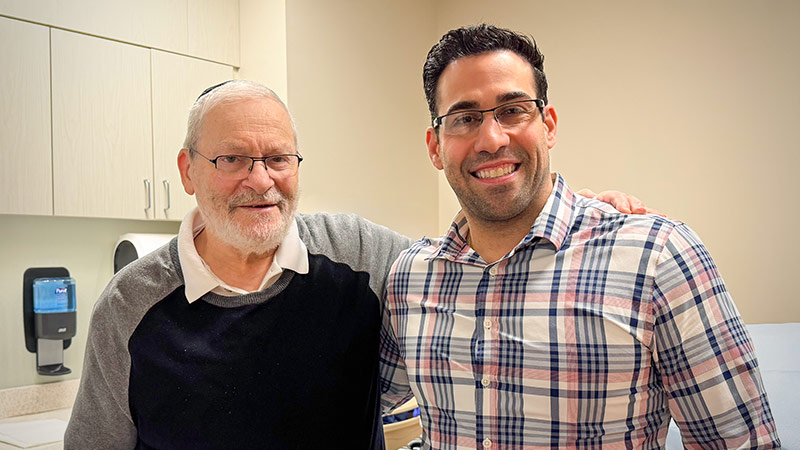
In May of 2023, then 78-year-old Elazer Lew of Lakewood, New Jersey, was on a walk in his neighborhood when, suddenly, he couldn’t take another step. “I wasn’t even in that much pain,” he says. “I just couldn’t lift my left foot up.
Elazer, who has a history of diabetes, heart disease and kidney disease, had recently developed a foot ulcer (a common complication of diabetes) that was being treated by a local wound center. He had been largely able to maintain his daily routine as a sixth grade teacher — until that day. “I was walking, and then I literally could not walk any further,” he says.
After developing a fever, he decided to call an ambulance; he was transported to Ocean University Medical Center in Brick. Little did Elazer know at the time, but he wouldn’t return to his home for nearly a year.
From Diagnosis to Losing Part of a Limb
At Ocean, Nicholas Russo, M.D., a vascular surgeon who specializes in limb preservation, examined his foot. Suspecting a blockage in an artery - another complication of diabetes - Dr. Russo performed a diagnostic test called an angiogram, which helps identify blockages and blood flow problems in the arteries and veins. The test revealed that multiple arteries in Elazer’s leg were heavily blocked.
According to Dr. Russo, diabetes is known to trigger widespread inflammation that, over time, injures and narrows the arteries that transport blood throughout the body. This can lead to infections and wounds, like Elazer’s foot ulcer.
“Not only do you have these arteries that are constantly inflamed, but you also have the fact that your immune system, and everything else, is inhibited by this constant inflammation, so it takes you longer to heal,” says Dr. Russo.
A week later, Dr. Russo performed a peripheral artery bypass to restore blood flow in Elazer’s left leg. The procedure was a success, and in the days that followed, Elazer appeared to be recovering well. A few weeks later, however, he developed a severe infection in his foot that “had eaten away a large portion of his foot,” says Dr. Russo.
Unfortunately, his foot could not be saved, so Dr. Russo recommended a below-the-knee amputation on Elazer’s left leg.
Elazer took the news well. “I said to myself, ‘I will not let this thing beat me,’” he says.
Dr. Russo regularly treats people with diabetes - they are about 10 times more likely than the general population to lose a limb - and believed Elazer would make a strong candidate for both the surgery and the demanding rehabilitation that would follow.
“He never struck me as the type of patient who was going to fold up shop and pack it in,” Dr. Russo says. “I wanted to get him back to a normal life as soon as possible.”
Overcoming an Unexpected Setback
A few months later, in August of 2023, Dr. Russo performed the procedure, surgically removing the leg, including all of the diseased tissue, below the left knee joint. Afterward, Elazer was transferred to a nearby rehabilitation facility.
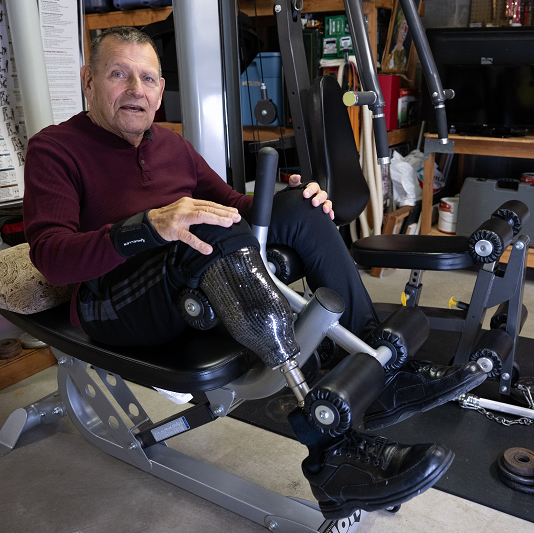
There, he began an intensive recovery regimen to build back his strength and learn how to walk with a prosthetic leg. “At first, I only wore it for 15 minutes a day, then 30 minutes a day, then an hour a day,” Elazer says. He had trouble putting it on in the beginning, but with time and practice, he gradually learned how to attach and rely on the prosthetic to get around.
Elazer was making great progress - until he encountered a setback. About a month after his surgery, his right foot began to show signs of an infection, due to his diabetes. Elazer was rushed back to Ocean, where a diagnostic angiogram revealed a serious blockage in his right leg. “I was very worried that they might have to amputate my right leg,” he says.
But Dr. Russo moved quickly. He performed a minimally invasive procedure called an angioplasty to restore blood flow to Elazer’s right leg. The procedure involved inserting a stent and a balloon to widen two major arteries. “Since he lost the left leg, I was going to make sure we kept the right leg,” says Dr. Russo.
The procedure went well, and blood flow was restored, but the underlying infection still needed to be addressed. So Elazer met with podiatrist James K. Holmes, D.P.M.,who determined that the big toe - where the infection was concentrated - needed to be amputated.
Unfortunately, a few weeks later, the second toe became infected and needed to be removed as well. To prevent the infection from spreading further, and to restore Elazer’s balance, the other three toes were also amputated.
Elazer maintained a positive attitude through it all. “The truth? I never let this thing get to me,” he says.
After his toe procedures, Elazer returned to rehab, where he resumed his physical therapy (PT) and occupational therapy regimen. He had a special shoe made for his right foot that helped him maintain balance and walk around.
“He took up boxing [as part of his physical therapy], and he was able to walk his granddaughter down the aisle, which was awesome,” says Dr. Russo.
In April of 2024, 11 months after he was rushed to Ocean, Elazer finally returned home.
Adjusting to Life After Amputation
At first, Elazer heavily relied on his wheelchair to get around his house. He didn’t immediately wear a prosthetic throughout the day. “I had to get used to it,” he says. But within a couple of months, he became more comfortable with it.
“Now, I put it on in the morning, and it goes on very easily. I wear it all day,” he says. He still does PT, now from the comfort of his home, four days a week.
He moves around the house with ease - to the kitchen, the bathroom, the front door - and prepares his own meals. “I do just about everything myself,” Elazer says.
He attributes his successful recovery to Dr. Russo and Dr. Holmes. “Both of them are extremely wonderful people,” he says. “I couldn’t have asked for better or more.”
The Power of a Strong Support System and a Positive Attitude
Throughout his journey, Elazer’s support system proved to be invaluable. At both the hospital and rehab facility, he regularly saw his extremely devoted wife, daughters, grandkids, friends and neighbors.
One day, his granddaughter put her visitor’s badge on the wall next to Elazer’s bed - a small gesture that became a ritual. By the time he checked out of rehab, he had over 300 photos on that wall.
Reflecting back, Elazer says his loved ones are what kept him going. But Dr. Russo also credits his positive attitude.
“He is one of those patients who is inspiring to have come to the office because it makes you realize and appreciate why you went into this specialty,” he says.
Next Steps & Resources
- Meet our source(s): Nicholas Russo, M.D.
- Make an appointment online with a vascular surgeon near you, or call 800-822-8905.
- Learn more about our vascular services.
One Woman’s Journey to Reverse Her Type 2 Diabetes
Crystal, age 35, completely changed her diet and exercise routines to lower her blood sugar level and lose weight.
Foot Care for Diabetics
Did you know that proper foot care can help prevent complications from diabetes down the road?
Finger Amputation Doesn’t Slow Down Landscaping Entrepreneur
Orthopedic oncology patient Victor Nuciforo is cancer-free after innovative surgery at Hackensack University Medical Center.
Amputation and Chemotherapy Save Life of 80-year-old Man
Bill Tarallo underwent a leg amputation while also receiving treatment for chronic lymphocytic leukemia at Hackensack University Medical Center.