

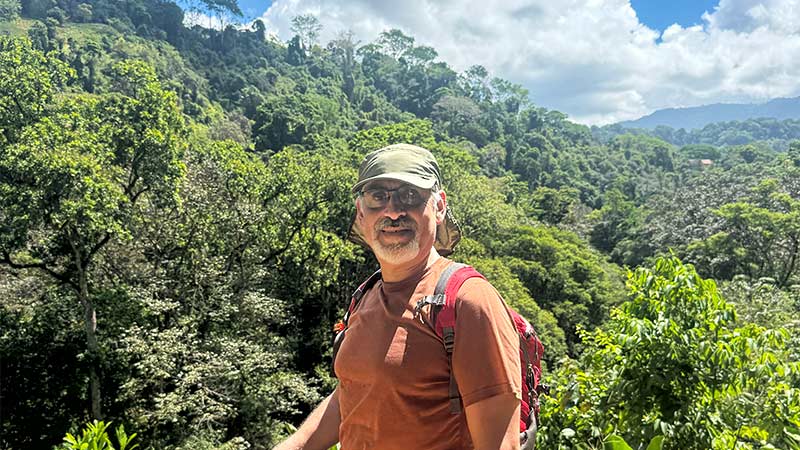
It was a quiet Sunday evening, and friends invited Michael Plavnik to join them for a swim at the club. When the group arrived, the pool was closed unexpectedly for maintenance, so Michael’s friends suggested racquetball instead.
Michael was more of a tennis player than a racquetball player, but he was happy to play along. Between racquetball sets, Michael felt a snap in his Achilles tendon (the tendon that connects the calf muscles to the heel bone). He knew something was very wrong. “It was like being hit with a stick.”
Achilles Repair: An Education and Options
Michael called Hackensack Meridian Health in Montclair the next morning for specialized orthopedic care. An MRI confirmed Michael’s suspicions about the seriousness of his injury, and he was referred to Daniel Murray, M.D., a foot and ankle orthopedic surgeon at Hackensack University Medical Center.
Dr. Murray’s approach impressed Michael from the start. Instead of rushing into a single treatment plan, Dr. Murray took time to educate Michael about all treatment options.
“It was a very educational session because he laid out the options and possible paths to recovery, including one without surgery, and what risks were involved in my particular case,” Michael says.
Michael’s Choice: a Smaller Surgical Footprint
Dr. Murray specializes in minimally invasive techniques that offer significant advantages over traditional approaches. For Michael’s Achilles repair, this meant smaller incisions, reduced scarring and faster recovery times.
Unlike traditional Achilles repairs that require large incisions, this technique uses much smaller surgical sites, creating what Dr. Murray calls “a smaller footprint for the surgery.”
“I chose a less invasive surgery,” Michael says, “because it gave me a better chance of playing tennis again.”
Detailed Recovery Plan Keeps Michael in Control
Michael’s surgical experience exceeded his expectations. The extremely professional team created a positive atmosphere that put him at ease.
Dr. Murray gave Michael detailed, stage-by-stage recovery instructions, empowering him to take control of his healing process.
The recovery process involved wearing a special boot with padding, which was gradually reduced every two weeks, allowing the Achilles tendon to strengthen progressively. Michael also committed to two months of intensive physical therapy.
Coming Back Stronger Than Before
One of the most remarkable aspects of Dr. Murray’s technique is that a repaired Achilles often becomes stronger than the original.
“My achilles is growing stronger than it was before,” Michael says.
By April, approximately six months after Michael’s surgery, Dr. Murray cleared him for normal activities and sports.
Looking Ahead and Michael’s Advice on Achilles Repair
Michael is taking a measured approach to returning to tennis, planning to restart this fall, which will be about eight months after his surgery.
“I’m 55 years old, right?” he says. “It’s not that my life is at stake here. I want to get back to tennis, but I’m planning to go slowly.”
For other people facing similar injuries, Michael’s advice is clear: Don’t let fear hold you back from getting the care you need.
“I highly recommend Dr. Murray. His hands are amazing,” he says.
Dr. Murray’s one-on-one approach and dedication to patient communication created a partnership that extended well beyond the operating room.
“During the recovery, he checked in with me twice a month to see what was going on,” Michael says.
Next Steps & Resources
- Meet our source: Daniel Murray, M.D.
- Make an appointment online with an orthopedic specialist near you, call 800-822-8905.
- Learn more about orthopedics and minimally invasive surgical techniques at Hackensack Meridian Health.
8 Reasons Your Hands and Feet Might Be Numb
Numb hands and feet? Learn 8 common causes from orthopedic experts. Find relief and treatment options. Call 800-822-8905.
5 Ways to Avoid a Pickleball Injury
Avoid pickleball injuries! Dr. Stamos shares 5 tips for injury-free play. Protect your health; get expert advice. Call 800-822-8905.
9 Ways to Reduce Foot Pain — Without Buying New Shoes
Foot pain is a common complaint. There are some DIY tips to help reduce foot pain without buying new shoes. But visiting a podiatrist may be your best option.
How to Heal a Sprained Ankle
Heal your sprained ankle. Dr. Bloomstein offers advice on treatment and recovery. Learn home care tips and when to seek medical help. Call 800-822-8905.