

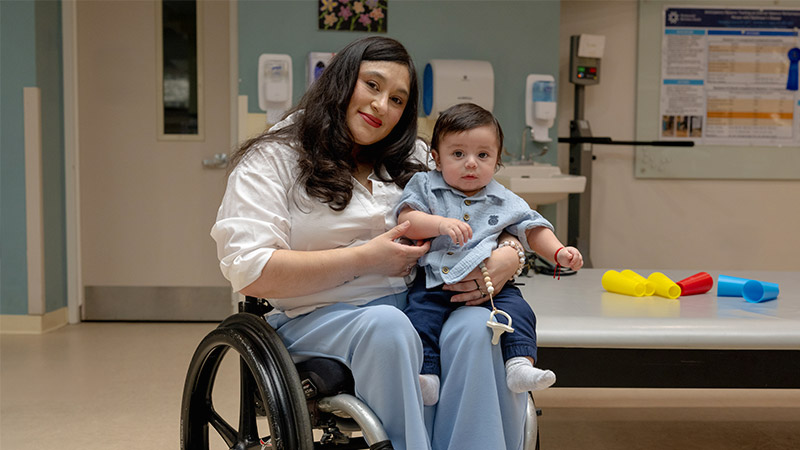
When Jessica Espinoza of Rochelle Park found out she was pregnant at a routine doctor’s appointment two years ago, she was shocked. The now-39-year-old, who has been paralyzed from the waist down since she was 12, didn’t think she could conceive.
“It was kind of confusing,” Jessica says. “I had a lot of emotions.”
Her mind raced with questions: What would pregnancy be like? What would it take to care for a baby while using a wheelchair?
She immediately reached out to Jennifer M. Chui, M.D., her physical medicine and rehabilitation physician at JFK Johnson Rehabilitation Institute, for support.
Getting the Right Care
Dr. Chui specializes in spinal cord injury (SCI); she helps Jessica navigate life with the SCI that left her paralyzed when she was 12.
The paralysis happened overnight — she woke up one morning and fell to the floor when she tried to get out of bed.
“I couldn’t walk. My sister ran to tell my mother,” she recalls. “No one knew what happened.”
Eventually, Jessica was diagnosed with a type of spinal cord injury called transverse myelitis, a rare neurological disorder that can cause paralysis due to inflammation of the spinal cord.
Like many women with SCI, Jessica wasn’t aware that she could get pregnant.
“Sometimes, because it’s such a sensitive topic, doctors don’t bring it up, and so people may not know what their options are for fertility, family planning, or even sexual health and intimacy,” says Dr. Chui, who has a certification in spinal cord injury medicine and has authored research on the topic.
Men who experience SCI can have dramatic changes to their fertility. But for women, fertility typically remains unaffected, Dr. Chui says. They can usually conceive and deliver a baby with no issues. ”We just have to be mindful of issues related to their spinal cord injury,” says Dr. Chui.
During delivery, “you may not be able to feel contractions, or you may not be able to push as adequately as someone who didn’t have a spinal cord injury,” Dr. Chui notes, “but that doesn’t mean that it’s not possible.”
That’s why she counsels all of her pregnant patients with SCI to talk with their OB-GYNs about their injuries and their birth plans. She also continues to meet with her patients with SCI throughout their pregnancies for extra support.
In addition to their OB-GYNs, “I’m another set of eyes and ears,” she says, which is comforting for many soon-to-be moms.
The Challenges of Pregnancy
As Jessica’s pregnancy progressed, things got more difficult. Her belly grew heavier, which made transferring in and out of her wheelchair harder. Driving became more challenging, so she needed more help than usual from her husband and sister to get to doctor’s appointments.
These kinds of issues are common, Dr. Chui says. “Your center of gravity is a little different,” she notes, which can change how a wheelchair user transfers in and out of their chair and travels up a ramp, for example. Some manual wheelchair users might add a power assist to their chairs during pregnancy and the postpartum period to help them navigate with more ease, she adds.
“The last few months of the pregnancy weren’t easy,” Jessica says. But at every ultrasound appointment, she was encouraged when she saw that her developing baby was doing well.
She wanted to have a vaginal delivery, and there was no medical reason why she couldn’t. But after several hours of labor, she ultimately had a cesarean section and delivered a healthy baby boy.
“So far, all of my pregnant patients with SCI have had successful pregnancies, whether they deliver vaginally or via C-section,” Dr. Chui says.
She attributes this to working closely with her patients to make sure they’re surrounded by the best team of providers. Some OB-GYNs have never worked with someone with an SCI before, she says, so it needs to be a team effort.
The Joy — and Lessons — of Motherhood
Recovering from a C-section made the early days of motherhood even more challenging for Jessica. She couldn’t transfer in and out of her wheelchair on her own until she healed from the surgery.
Over time, she figured out how to maneuver her wheelchair with one hand while holding her baby in the other. And she learned to manage tasks such as changing his diaper and feeding him. When her husband went back to work, her cousin and sister pitched in to help.
Today, her son is a year and a half old and thriving.
“Every day, I learn something from him,” Jessica says. “I look at him growing so fast — it’s something I never expected for my life. People will tell you that certain things can’t be done when you use a wheelchair, and you just have to believe in the miracle that they can.”
Next Steps & Resources
- Meet our source: Jennifer M. Chui, M.D.
- Make an appointment online with a physical medicine and rehabilitation specialist near you, or call 800-822-8905.
- Learn more about our rehabilitation services.
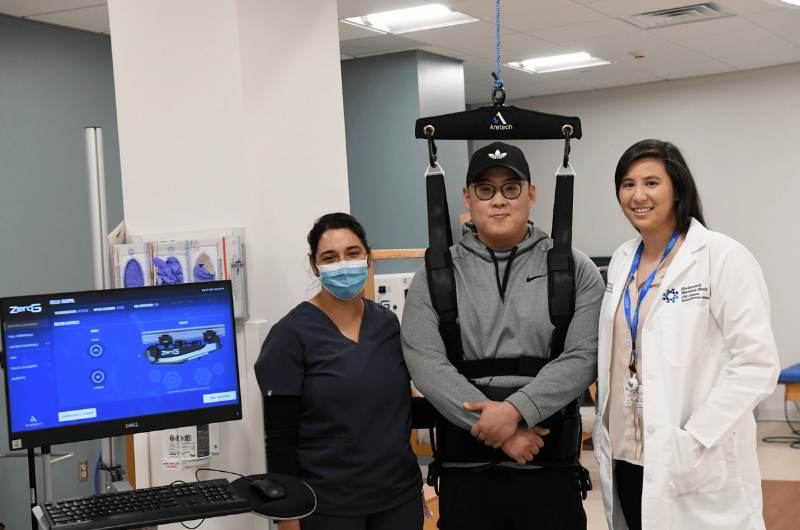
Metuchen Man Takes More Steps Each Day After Spinal Cord Injury
JFK Johnson Rehabilitation Institute’s specialized care helps a 32-year-old man walk again after a spinal cord injury.

How to Strengthen Your Back and Avoid Injury
Strengthen your back & avoid injury. Learn expert tips from Dr. Tawfik at Ocean Medical Center for better posture, healthy habits, and spine health.

5 Easy Spinal Stenosis Exercises
Ease spinal stenosis symptoms with 5 easy exercises. Dr. Roth recommends these simple movements to improve your flexibility and strength. Call 800-822-8905 for help.

5 Ways to Keep Your Spine Healthy
Spine health is important for your overall health. Learn how to keep your spine healthy from Hackensack Meridian Health experts.