Hearing that you may need a lung biopsy can feel overwhelming. You might wonder what the procedure involves, how invasive it will be or how quickly you’ll get answers. Thankfully, lung biopsy technology has come a long way. Today, there are highly precise options that use no incisions going through the airway, making the experience easier and painless.
One of the most promising advances is robotic bronchoscopy, an innovative biopsy technology that was first performed in New Jersey at Hackensack University Medical Center. “Using technology such as the ion robotic bronchoscopy, we can localize, diagnose and even treat small lung nodules without making any incisions and patients can go home the same day”” says Stuart Campbell, M.D., a cardiothoracic surgeon at HMH.
However, robotic bronchoscopy isn’t right for every patient. Dr. Campbell answers questions about how the technology works and who it can potentially help.
How Is a Lung Biopsy Done Using Robotic Bronchoscopy?
First, it’s important to understand that lung biopsies can be performed in a few different ways. In a conventional biopsy, a needle is guided through the chest wall into a lung nodule to collect a tissue sample.
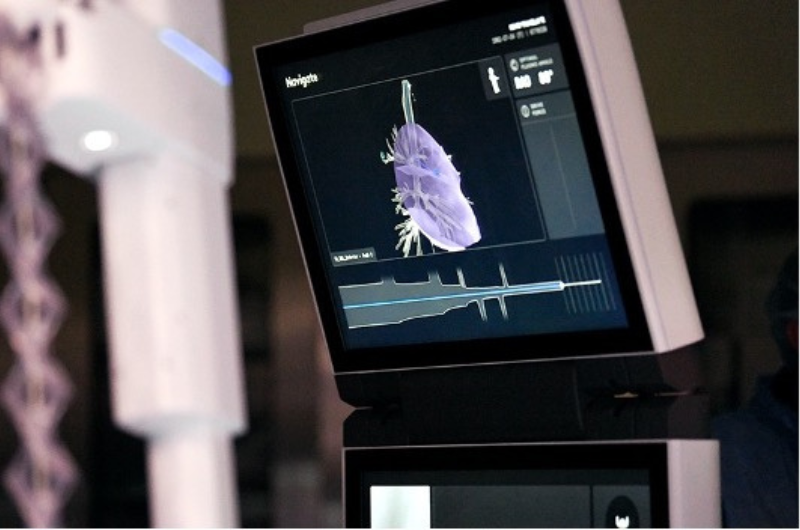
In a robotic bronchoscopy, Dr. Campbell explains, a robotic-assisted catheter is used to move through the airways.
“It enables doctors to gently navigate to hard-to-reach or very small lung lesions,” he says. “It gives us better control and better reach, which can make the biopsy more accurate.”
This is an important step in diagnosing lung cancer early, when it’s typically more treatable.
According to the American Lung Association, the five-year survival rate is 63 percent for those diagnosed at the early, localized stage versus 8 percent for those diagnosed after the tumor spread to other parts of the body.
The process starts with a detailed CT scan that maps out your airways. Using this imaging, the team creates a virtual road map to the exact spot they need to biopsy.
“We use the software to plan our route,” says Dr. Campbell. “Once we reach the area, we take a real-time CT scan to make sure the catheter is right where it needs to be. That way, we know we’re sampling the correct lesion.”
These procedures typically take about 30 to 60 minutes. There are no incisions, and the risks of bleeding and pneumothorax are very low which make it a well tolerated, low risk procedure..
Who Is a Good Candidate for Robotic Bronchoscopy?
If you’re a candidate for a lung biopsy, speak to a thoracic surgeon about options that are best for you.
“There are instances when robotic bronchoscopy is not right, depending on the lesion, so talk to your doctor about the best treatment plan,” Dr. Campbell cautions.
In general, robotic bronchoscopy can be helpful if:
- Your nodule is too small or risky to reach from outside the chest
- You have more than one lesion that needs to be checked
- Your surgeon wants to place a marker for a future procedure
Thoracic surgeons and pulmonary specialists at HMH often collaborate to provide patients with personalized, targeted treatment plans. Additional treatment, such as Aliya ablation, is also being considered.
Are There Other Technologies That Support Lung Treatment?
Robotic bronchoscopy isn’t the only innovative tool available to patients at HMH.
One of the newest treatment options is called Aliya, a nonthermal ablation technology that can precisely treat select lung lesions. This is a less invasive procedure that means patients can recover faster.
Another tool called Cytalux is a dye that helps surgeons see very small nodules during minimally invasive procedures, ultimately improving cancer detection.
Both are designed to support more targeted, lung-preserving treatment.
“These technologies help us focus on exactly what needs attention,” Dr. Campbell says. “They allow us to personalize care in ways we couldn’t before.”
Artificial intelligence (AI) is beginning to play a role in lung care, too. AI will be leveraged to help identify more lung nodules that may have been missed, and to help doctors discern between benign and concerning nodules.
Next Steps and Resources:
- Meet our source: Stuart Campbell, M.D.
- Make an appointment online for a biopsy, or call 800-822-8905.
- Find a thoracic or pulmonology specialist near you.
- Learn more about lung care at HMH, home to one of the top-ranked thoracic surgery and pulmonary medicine divisions in the Tri-State area, recognized by U.S. News & World Report.
Doctors Find Rare Cause of Kidney Stones in Infant
Under Armpit Bump Signals Lung Cancer for NJ Woman
A Fast Recovery from Lung Cancer Surgery