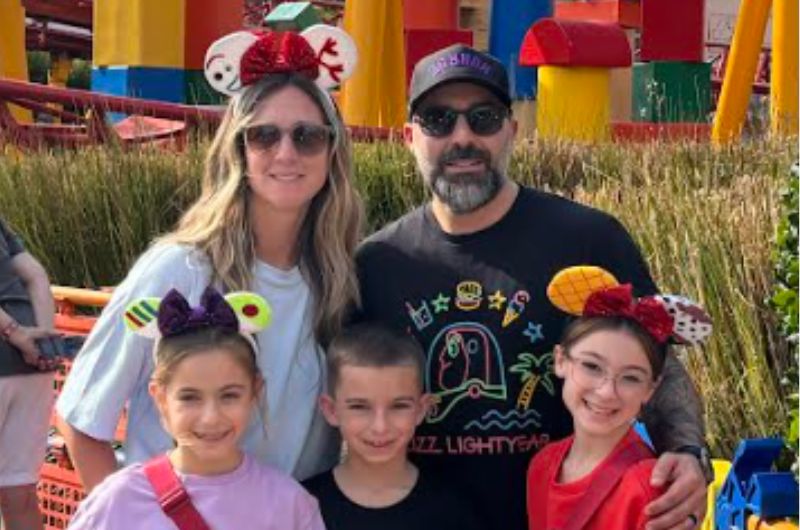
At 38, Monroe resident Nichole Molinaro was juggling life as an active mother of three young children. Lung cancer wasn’t on her radar. She had never smoked. There was no family history. She exercised regularly and considered herself healthy.
So when she began experiencing chest pain in 2024, she chalked it up to stress, anxiety, or overdoing it at the gym.
“I didn’t think anything of it,” Nichole says.
But when her chest pain didn’t go away, she contacted her primary care physician, who ordered a chest X-ray, followed by a CT scan. The imaging revealed a small but concerning finding: a nodule in her right upper lung.
She was referred to Faiz Bhora, M.D., professor and regional chair of Surgery and chief of Thoracic Surgery Central Region at JFK University Medical Center.
Robotic Surgery Leads to Early, Life-Saving Diagnosis
After reviewing the imaging, Dr. Bhora recommended robotic-assisted surgery to remove the nodule and definitively determine whether it was cancer. Because the nodule appeared hollow rather than solid, a biopsy was unlikely to give them a reliable result.
“He explained that the best option was to remove it,” Nichole says. “That way, we’d know for sure.”
Using robotic technology—designed to access hard-to-reach areas of the lung with precision—Dr. Bhora performed the procedure. Pathology confirmed early-stage lung cancer.
Nichole was fortunate. Most patients are diagnosed much later.
“By the time people develop symptoms like a persistent cough, chest pain, or coughing up blood, lung cancer is often advanced,” Dr. Bhora explains. “Early detection changes everything.”
In Nichole’s case, the cancer was found at its earliest stage—completely by accident.
“The chest pain wasn’t even related,” she says. “I honestly believe something was telling me to get checked. When you read what could have happened if this was missed, it’s terrifying.”
Because the cancer was caught so early and removed with a tailored surgical approach, Nichole did not need chemotherapy or radiation—and her long-term outlook is excellent.
Lung Cancer Can Affect Anyone
While smoking remains the most significant risk factor for lung cancer, a growing number of patients diagnosed today have never smoked.
“I had no risk factors,” Nichole says. “No family history. No smoking. I’ll probably never know where it came from.”
According to Kostantinos Poulikidis, MD, a thoracic surgeon on Dr. Bhora’s team, Nichole’s story is becoming increasingly common.
“Lung cancer doesn’t discriminate,” he says. “We’re seeing more young, otherwise healthy patients—many of whom have never smoked. Awareness is critical. Risk can exist even when you least expect it.”
Using a Team Approach to Save Lives
Lung cancer remains the leading cause of cancer death in the U.S., largely because it is often diagnosed late. Fewer than 20 percent of people eligible for lung cancer screening actually undergo it.
As in Nichole’s case, many cancers are discovered incidentally—during imaging for unrelated symptoms such as chest pain or heart concerns.
“At JFK, we see lung nodules routinely,” says M. Jawad Latif, M.D., site chief of thoracic surgery at JFK University Medical Center. “Most are benign. However, when cancerous nodules are detected early, with treatment, outcomes can be improved dramatically.”
Patients benefit from a multidisciplinary team approach, bringing together thoracic surgeons, pulmonologists, oncologists, nurse practitioners, and physician assistants to tailor care to each individual.
“It’s truly a team effort,” Dr. Bhora says. “And that collaboration makes all the difference.”
Finding Peace After a Frightening Diagnosis
Today, Nichole returns to JFK University Medical Center a few times a year for routine follow-up imaging. Dr. Bhora personally reviews each scan.
Hearing the word cancer was terrifying, she says—but the care she received helped replace fear with confidence.
“Every time Dr. Bhora walked into the room, there was comfort in his voice,” Nichole recalls. “He made me feel safe—like everything was under control.”
For Nichole, the stakes were clear.
“I have three small kids,” she says. “They need their mom.”
Her message to others is simple: listen to your body, and don’t assume you’re not at risk.
“It’s easy to dismiss things,” she says. “I’m so glad I didn’t.”
Next Steps & Resources
- Meet our experts: Kostantinos Poulikidis, M.D., M. Jawad Latif, M.D and Faiz Bhora, M.D.
- Make an appointment online with a thoracic surgeon near you, or call 800-822-8905.
- Learn more about thoracic surgery at Hackensack Meridian Health.
Under Armpit Bump Signals Lung Cancer for NJ Woman
Don't Wait for Symptoms: A Powerful Plea for Lung Cancer Screening from a Former Smoker