

Program Details
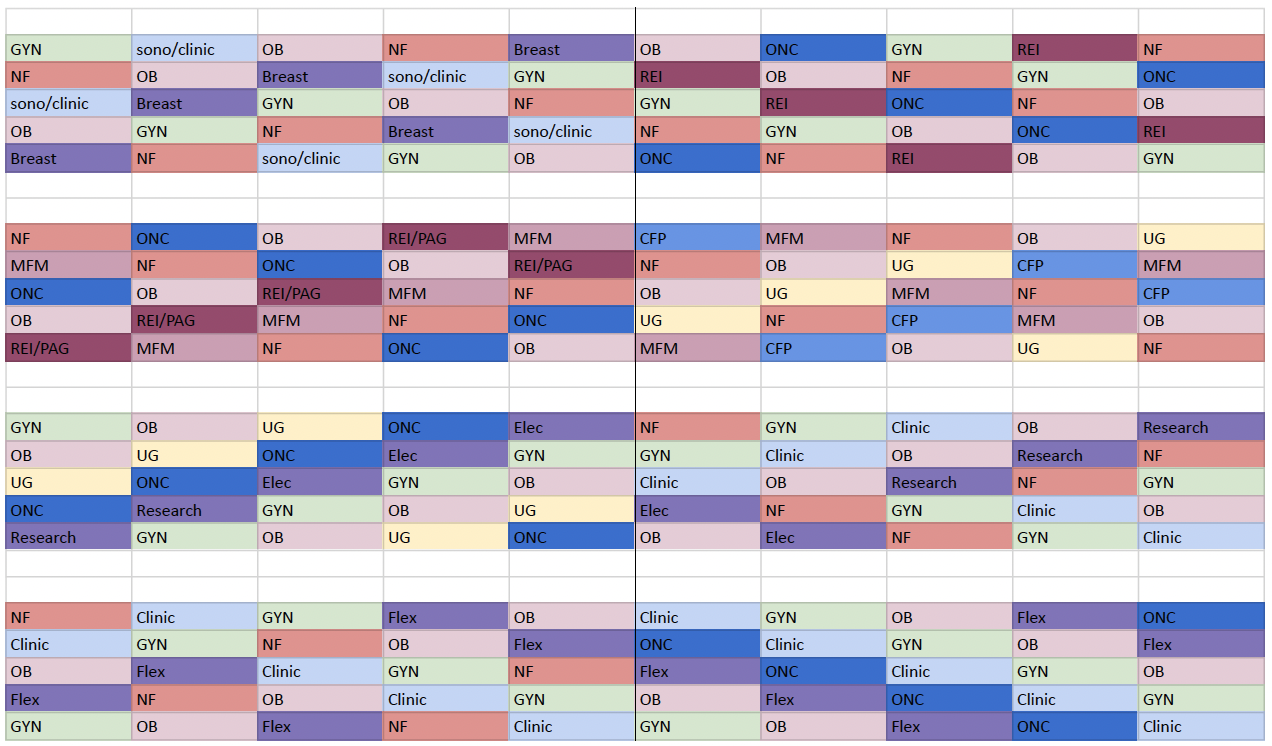
Our residents rotate through general obstetrics and gynecology and various subspecialties:
- Reproductive Endocrinology & Infertility
- Gynecologic Oncology
- Urogynecology and Reconstructive Pelvic Surgery
- Maternal Fetal Medicine
- Complex Family Planning
- Pediatric and Adolescent Gynecology
- General Obstetrics
- General Gynecology
- Breast Surgery
- Outpatient obstetric and gynecologic care
Rotation Schedule
Goals & Learning Objectives
The goals of this program are designed to utilize a coordinated academic and pragmatic clinical environment to teach our residents the clinical skills, didactic knowledge, and professional attitude needed to practice Obstetrics and Gynecology.The Department has adopted the Educational Objectives: Core Curriculum for Residents in Obstetrics and Gynecology of the Council on Resident Education in Obstetrics and Gynecology, 9th edition. In addition to the specific CREOG Educational Objectives, the Department’s goals include:
- To educate, assess, and demonstrate competency in patient care, medical knowledge, communication skills, professionalism, practice-based learning and improvement, and systems-based practice.
- To develop complete proficiency in the diagnosis and management of all clinical problems in general obstetrics and gynecology.
- To provide educational opportunities that enable the resident to excel in the practice of obstetrics and gynecology.
- To stimulate the intellectual curiosity of the resident and develop proficiency in the analysis and interpretation of the medical literature.
- To establish a commitment to life-long learning through self-education and teaching others.
Educational Goals & Objectives
- Emergency Room Rotation (Year 1) (ER-PGY1)
- Gynecologic Oncology Rotation (Year 3) (ONC-PGY3)
- Gynecology Rotation (Year 1) (GYN-PGY1)
- Gynecology Rotation (Year 4) (GYN-PGY4)
- Night Float Rotation
- Obstetrics Rotation (Year 1) (OB-PGY1)
- Obstetrics Rotation (Year 2) (OB-PGY2)
- Obstetrics Rotation (Year 3) (OB-PGY3)
- Obstetrics Rotation (Year 4) (OB-PGY4)
- Reproductive Endocrinology & Infertility Rotation (Year 2) (REI-PGY2)
- Urogynecology Rotation (Year 2) (UROGYN-PGY2)
Rotations and their particulars are subject to change. The information presented is a compilation from a variety of educational sources including Education Objectives, 8th and 9th Editions and information and concepts compiled from APGO/CREOG/ACOG.
Examinations & Evaluations
Resident Evaluations
We appreciate the value of honest, productive, evaluations which help improve our skills and expertise. On a quarterly basis, residents receive comprehensive feedback — including observations from peers, medical students, nurses, faculty, and patients. Residents also meet with the program director at least twice a year. Conversely, residents are also given the opportunity to evaluate the program and faculty.
Resident Exams
Once a year, the residents take the CREOG examination, a comprehensive written examination in obstetrics and gynecology.
Resident Mentors
During the first year of residency, each resident identifies a faculty member as their advisor. They meet formally twice each year and informally as needed. It is a chance for the resident to develop a personal relationship with an experienced physician to discuss professional goals and individual issues.