

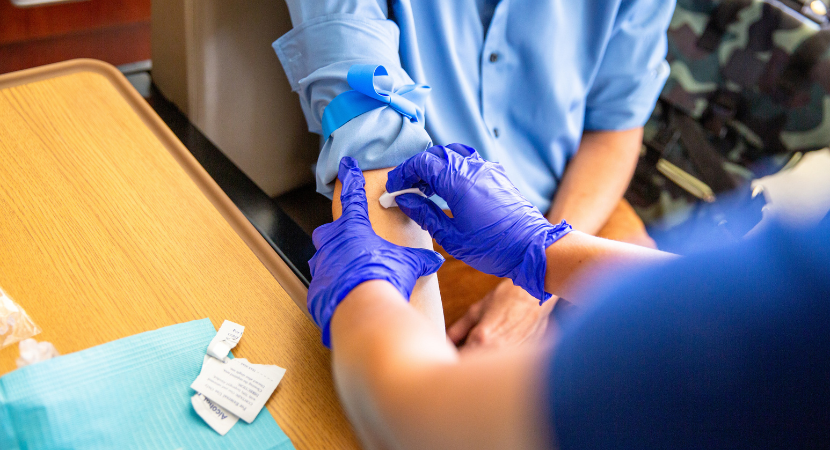
If you smoke or used to smoke, your doctor may have talked to you about getting a low-dose CT scan — a noninvasive test that takes detailed images of your lungs to check for cancer.
It’s a highly accurate test, but many people put it off or skip it altogether, says Helen Nunez, APN, a nurse practitioner at Hackensack Meridian Health’s Hennessy Institute for Cancer Prevention & Applied Molecular Medicine. Reasons include everything from being claustrophobic (the test requires lying on a table inside a machine for 10 minutes) to being scared of finding out something is wrong.
But a new screening test for lung cancer may change that. Called FirstLook by DELFI Diagnostics, the simple lung cancer blood test can determine if you’re at risk for lung cancer and help your doctor decide if you need further screening, such as a low-dose CT scan.
Nunez hopes it will lead to more people getting screened for lung cancer. “The biggest challenge in early lung cancer detection isn’t the technology. It’s getting people to use it,” she says.
Here’s how the new technology works — and how it can reduce your risk of lung cancer.
What is the new lung cancer blood test?
FirstLook is a simple blood test that assesses your likelihood of having lung cancer. You get your blood taken, just as you would during a routine blood draw, and you receive your results within two weeks.
The test works by detecting fragments of DNA from tumors in your blood, explains Nunez. (With certain kinds of cancer, including lung cancer, large tumors shed DNA into your bloodstream.)
The test produces two results — elevated or not elevated. If your test results come back as elevated, that doesn’t mean you have lung cancer — it indicates that you need additional testing, such as a low-dose CT scan, to check for cancer.
If your test result is not elevated, the likelihood you have lung cancer is extremely low, says Nunez. Additional testing usually isn’t ordered in this case.
How can this lung cancer blood test improve cancer outcomes?
FirstLook is quite effective at predicting lung cancer: It has a sensitivity of 80%, meaning it can correctly predict cancer in 8 out of 10 people who have it.
It’s also good at predicting when someone doesn’t have cancer. It has a negative predictive value of 99.8%, which means it’s right 99.8% of the time when it predicts someone doesn’t have lung cancer.
On the flip side, FirstLook can sometimes produce a false positive. But it’s important to remember that this is not a diagnosis—it simply means a follow-up low-dose CT scan is recommended.
FirstLook can help improve cancer outcomes by flagging people who may have lung cancer earlier,
when it’s at its most treatable stage, before symptoms appear and it has spread.
Lung cancer that has spread is harder to treat. The five-year survival rate for those with stage IA lung cancer exceeds 90%, whereas it’s less than 10% among those diagnosed with stage IV disease.
Who is a good candidate for the test?
To qualify for FirstLook, you must meet all three of these requirements:
- Have a 20 pack-year (meaning you smoked the equivalent of a pack a day for 20 years) or more smoking history
- Currently smoke or have quit within the past 15 years
- Are between 50 and 80 years old
FirstLook does not replace CT scans, which continue to be the gold standard for lung cancer diagnosis, Nunez stresses.
“It is not a diagnostic test, but rather a tool to help inform the conversation between you and your healthcare provider about proceeding with standard screening,” she says.
How to get tested
Hackensack Meridian Health’s Hennessy Institute for Cancer Prevention & Applied Molecular Medicine has spearheaded the research and distribution of FirstLook.
“We want to empower our communities with knowledge and provide them with the most cutting-edge information that exists. So, if they have cancer, we can find it earlier when there are more treatment options,” Nunez says.
Nunez has seen first-hand how fearful some patients are about undergoing CT scans and how concerned they can be that their providers will judge them for smoking. “We have to meet the patients where they are,” she says, “and if people are more comfortable with blood work, which many people are accustomed to getting done routinely, then why not?” she says.
Looking ahead, Nunez hopes FirstLook will boost early lung cancer detection rates and, ultimately, lung cancer outcomes. She encourages anyone interested in early lung cancer detection to ask their doctor about FirstLook.
Next Steps & Resources:
- Meet our source: Helen Nunez, APN
- Make an appointment online with a physician near you, or call 800-822-8905.
- To participate in the Hennessy Institute’s research on FirstLook, reach out to hicapresearch@hmhn.org.
- Call 848-245-8011 to make an appointment for a lung cancer screening at one of our convenient locations.
- Learn more about lung cancer care at Hackensack Meridian Health.
Find a doctor near me

Does Smoking Weed Cause Lung Cancer?
Smoking weed: Lung cancer risk? Dr. Vega explains weed's lung effects and offers guidance. Learn more and schedule an appointment today.
A Fast Recovery from Lung Cancer Surgery
Fast Lung Cancer Surgery Recovery. Learn about minimally invasive options and a patient's positive experience. Call 800-822-8905.

Under Armpit Bump Signals Lung Cancer for NJ Woman
Despite having no family history, non-smoker Debbie Cihoski was diagnosed with stage 1 lung cancer. A warning bump under her left armpit saved her life.

Catching Lung Cancer Early
Early lung cancer detection saves lives. Learn how Diana's early diagnosis at Jersey Shore University Medical Center led to successful treatment. Get the information you need.