

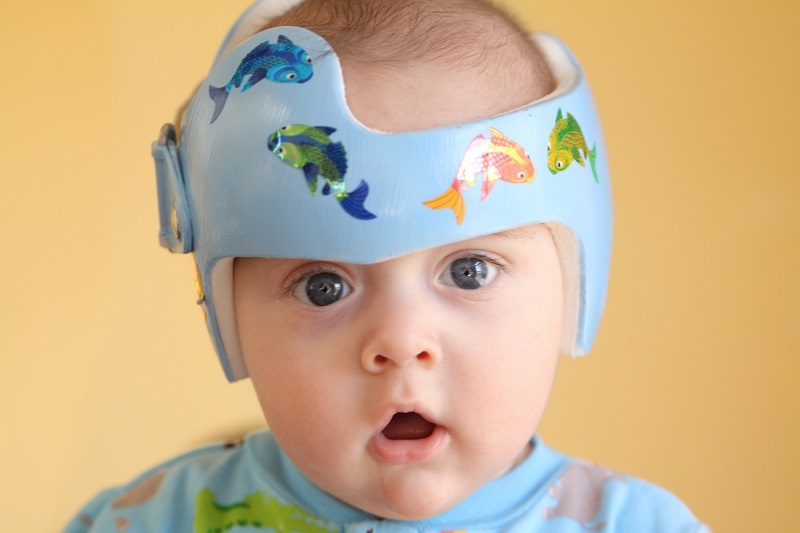
Not every baby’s head shape looks exactly the same. But as babies grow, a misshapen head could be a sign of a condition that requires helmet therapy to correct.
We spoke with Lawrence Daniels, M.D., a pediatric neurosurgeon at Jersey Shore University Medical Center, about how helmet therapy—also known as cranial remolding therapy—can help.
When Is Helmet Therapy Needed?
A baby may be prescribed helmet therapy for a number of conditions, including:
Flat Head Syndrome: Helmet therapy may be needed to resolve two types of flat head syndrome: positional plagiocephaly (partial flattening of one side of the head) and positional brachycephaly (flattening of the back of the head). “These conditions most commonly represent a normal development and rarely require helmet therapy,” Dr. Daniels says. “On rare occasions, where the deformity is extreme and severe or the babies have other medical conditions that prevent them from repositioning on their own, helmet therapy may be required.”
Flat head syndrome may be caused by:
- Sleeping on the back
- Baby position in the womb
- Premature birth
- Torticollis (Neck muscle tightness)
Craniosynostosis: Craniosynostosis is a rare genetic condition where a baby’s bones in the skull join together too early. That abnormality can limit brain growth and lead to intellectual disabilities when not corrected. When two separate surgeries are needed to address craniosynostosis (which is the case at many hospitals), a helmet is worn during the time between the two surgeries.
“But for some patients, At Hackensack Meridian Children’s Health, we are successfully performing craniosynostosis surgery in a single procedure,” Dr. Daniels says. “This not only avoids 24/7 helmet therapy for these children but also decreases the risks associated with multiple surgeries.”
How Does Helmet Therapy Work?
Helmets are made with a hard outer shell and foam inner lining. “They are custom-fitted so that they inhibit growth in prominent areas and allow growth in flat areas,” Dr. Daniels says. ”Adjustments to fit are made frequently as a baby’s head grows.”
Helmets need to be worn about 23 hours a day, taken off for bath time but left on for all other activities, including sleeping, playing and feeding. “The duration of helmet therapy depends on the child—their age and the severity of their condition,” Dr. Daniels says. “Therapy should begin around 4–6 months, and is usually ineffective after age 1 since the skull starts to fuse together by then.”
When Other Treatment Is Needed
For the majority of plagiocephaly and brachycephaly cases, the condition doesn’t affect brain development or growth. Most cases improve as the child gets older and spends more time standing and sitting.
“But if a baby’s flat head is caused by stiff neck muscles, that can slow early development,” says Dr. Daniels. “So if your doctor recommends physical therapy exercises, it’s important to follow that guidance.”
Craniosynostosis, on the other hand, likely requires surgery to relieve the pressure in the skull and allow the brain to grow normally. “Surgery can reduce the risk of complications such as developmental delays, seizures and even blindness,” Dr. Daniels says. “This isn’t a condition you can take a ‘wait and see’ approach about.”
Next Steps & Resources:
- Meet our source: Lawrence Daniels, M.D.
- To make an appointment with a pediatrician near you, call 800-822-8905 or visit our website.
Find a doctor near me

Is Your Child a Picky Eater? Try These Tips
Help your picky eater thrive! Get expert tips from Dr. Peardon to encourage healthy eating habits. Call 800-822-8905.

The Essentials for Your Baby: A Tool Kit
Newborn baby essentials checklist. Dr. Tuma shares must-have items for feeding, sleeping, and more. Prepare for baby's arrival. Call 800-822-8905.
Should I Get My Child Vaccinated?
Child COVID-19 vaccination: Doctors Clouser & Pall explain safety, benefits, and scheduling. Protect your child. Call 800-822-8905.

Can You Avoid Postpartum Depression?
Avoid postpartum depression? Learn steps to support your well-being. Get expert advice from Lauren Murphy, MSN, RN. Call 800-822-8905 for help.