

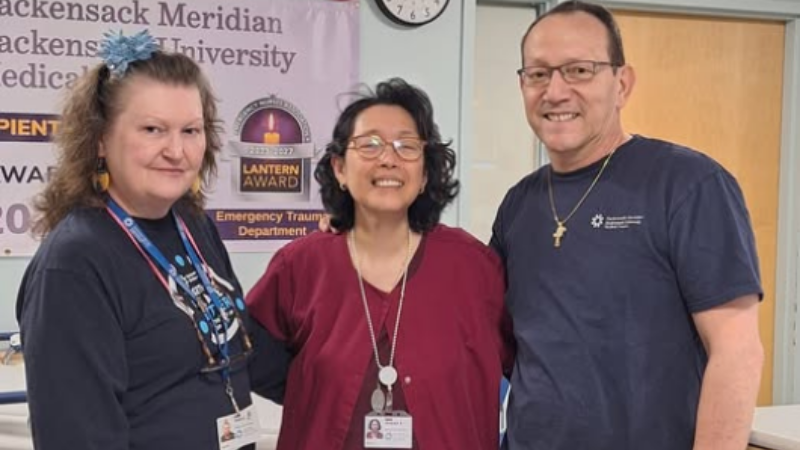
When Andie first turned 45 in 2016 and reached the age for regular colonoscopies, she didn’t think twice before taking her primary care physician’s advice and scheduling an appointment. As a patient care technician in the pediatric emergency department at Joseph M. Sanzari Children’s Hospital at Hackensack University Medical Center, she takes her health seriously, and this decision changed her life.
An Intimidating Screening
Ten years ago, Andie was anxious about scheduling her first colorectal cancer screening.
Like her friends, Andie found the prep process intimidating. “It was so scary!” she says with a laugh. “I had to take this preparation, be on a clear liquid diet, have nothing to eat.”
She made an appointment with the team she loves: her work family at Hackensack University Medical Center.
Fortunately, the screening itself was nothing to worry about, and the results came back negative. “I was fine,” Andie says. “I said, ‘I don’t need to do it again.’” But unfortunately that wasn’t the case.
A Surprising Result
As a person with average risk, Andie’s doctor recommended she go for colonoscopies every ten years. Her past experience – with both difficulty during the preparatory process and a negative result – made her hesitant to do it again, but ultimately she scheduled the appointment.
Once again, she scheduled her appointment at her beloved Hackensack University Medical Center. Anila Kumar, D.O., her gastroenterologist this time around, soothed her anxiety.
“Dr. Kumar, the anesthesiologists, the nurses, the clerks, the PCTs – they all said it was going to be okay. They were all so sweet. It was a great team,” she says.
Before she knew it, she was waking up after “the best rest ever.” The nurses told her everything went well, took her vitals and gave her something to eat.
Then Dr. Kumar explained they’d found a tiny polyp, which they would send to the lab for biopsy.
A few days later, Andie received a call with the results. While the polyp was malignant, it was fully removed during the screening — meaning that Andie was cancer free.
Gratitude and Advocacy
Now, because of her positive result, Andie will get colonoscopies every eight years – a change she welcomes.
She now advocates for everyone to get their screenings. “If I hadn’t gone when I did, it could have been full blown,” she says. “Don’t let fear overcome your health. People are afraid of it, but the fear of cancer is worse. That’s reality.”
Colonoscopies aren’t the only thing that Andie now promotes. She is proud to spotlight the team that helped to find and remove her cancer.
“The HMH team when I had my colonoscopy – from 1 to 10, they’re a 10,” Andie says. “It’s a wonderful experience to know you’re being taken care of, just like we take care of children in the pediatric ER.”
Next Steps & Resources
- Meet our source: Anila Kumar, D.O.
- Make an appointment online for a colonoscopy near you, or call 800-822-8905.
- Learn more about gastroenterology.

When Should You Get Screened for Colorectal Cancer? Earlier Than You Think
As colorectal cancer rises in young people, screening earlier is more important than ever. Learn when and how to get screened.
When To Get A Colon Cancer Screening
While most cases of colon cancer happen in those over 50, cases of colon cancer are rising among those under 50. Read on to know if you are at risk and should be screened.

Is Gut Health Linked to Colon Cancer?
Gut health and colon cancer: Learn how your microbiome impacts colon cancer risk and how to improve gut health with simple dietary changes. Call 800-822-8905.
Am I at Risk for Colorectal Cancer? Understanding Genetic Factors and Early Detection
Worried about colorectal cancer? Learn how your genes play a role and discover early detection options, including genetic testing and screening.