

Key Takeaways
Simulation technology helps doctors plan brain aneurysm treatment by testing devices on a 3D model.
- How it works: Your doctor loads 3D images of your aneurysm into software that shows how different devices would help treat it.
- Benefits: Planning ahead helps your doctor choose the best-fitting device and can cut treatment time and radiation exposure.
- Get care: If you’ve been diagnosed with a brain aneurysm, a neurosurgery provider can help: Book online | 800-822-8905
Medically reviewed by Daniel E. Walzman, M.D., Neurosurgeon, Hackensack University Medical Center
Treating a brain aneurysm is complex. The size, shape and location of your aneurysm determine which medical device your doctor uses to treat it.
Now, using software from Sim&Cure, your doctor can build a 3D model of your blood vessels and virtually try different approaches. This offers a more personalized look at what may happen during the actual procedure, with no risk to you.
“I do believe that every aneurysm has a single best treatment,” says Brian Jankowitz, M.D., chief of neurosurgery at the Hackensack Meridian Neuroscience Institute at JFK University Medical Center in Edison. This technology helps him decide.
Here’s how it works and what it means for you.
What is a brain aneurysm, and how is it treated?
A brain aneurysm is a weak spot in a brain artery wall that usually develops over years from wear and tear, Dr. Jankowitz says. Some aneurysms never rupture; those that do can cause bleeding in the brain and lead to stroke.
Brain aneurysm treatment depends on the aneurysm’s characteristics. You may need open surgery or endovascular treatment, a minimally invasive procedure performed through a blood vessel.
During the procedure, your doctor may use devices such as clips, coils, stents or intrasaccular flow-disruption devices (mesh implants) to treat the aneurysm.
Choosing the right device can be challenging since every person’s blood vessels are different.
What is simulation technology for brain aneurysm treatment?
Simulation technology turns 3D images of your aneurysm into a computer model of your blood vessels, so your doctor can test how different devices would sit in the artery around your aneurysm.
That detail helps because devices come in one width, while a single artery can be wider in some spots and narrower in others, says Daniel E. Walzman, M.D., chief of vascular and endovascular neurosurgery at Hackensack Meridian Neuroscience Institute at Hackensack University Medical Center.
JFK was the first hospital in the Northeast to make the software part of standard care, Dr. Jankowitz says. It’s also available at Hackensack University Medical Center.
How does it work?
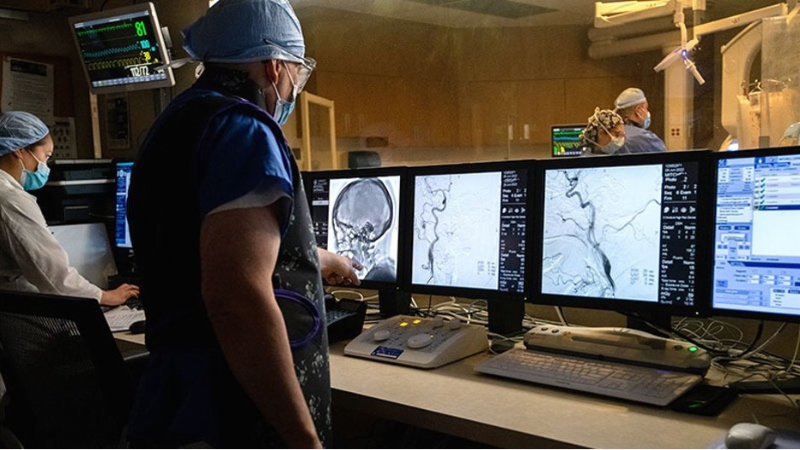
To get the 3D images needed to create the model, your doctor performs a cerebral angiogram, a minimally invasive test that takes 30 to 45 minutes, Dr. Walzman says.
Then, your doctor uploads the images to the software to simulate how different devices will work with your unique anatomy. Running the simulation usually takes two to five minutes.
What are the benefits?
- A better fit: Simulation helps your doctor choose the right device and size for your anatomy, says Dr. Walzman. “We did a really great job treating patients before we had the software, but I think it’s definitely added one more layer of safety,” he adds.
- A smoother procedure: Planning ahead can cut treatment time, radiation exposure and the need for extra devices, according to published research and Dr. Jankowitz.
- A clearer picture: Your doctor can use the 3D model to walk you through your options.
“I have had patients who were adamant that they didn’t want treatment. They were too afraid,” Dr. Jankowitz says. But seeing how their brain will respond to treatment makes them more comfortable with trying it.
Donna’s story: Catching a Returning Aneurysm
Donna McClure had already survived a ruptured brain aneurysm, treated at JFK with coiling and clipping in March of 2023.
In late 2025, the retired childcare center owner from Union Beach felt fine at her annual aneurysm scan.
Then, to her surprise, the imaging showed the aneurysm had come back. A returning aneurysm often causes no symptoms and shows up only on follow-up scans, Dr. Jankowitz says.
His team used simulation technology to compare options before choosing a flow diverter, placed across the aneurysm’s opening to steer blood away from it.
“Throughout this entire ordeal, the doctors and staff at JFK were wonderful,” says Donna. “They explained everything thoroughly, answered questions I didn’t even think to ask and gave me complete confidence in them.”
Donna healed well, didn’t need physical therapy and is off the blood thinners she had to take post-surgery. “I feel good, and my life is the same as it was before,” she says.
Next Steps & Resources:
- Meet our sources: Brian Jankowitz, M.D., and Daniel E. Walzman, M.D.
- Learn more about neuroscience care at Hackensack Meridian Health.
Find a doctor near me

What Causes a Brain Hemorrhage?
Learn brain hemorrhage causes from leading neurosurgeon Dr. Steineke. Understand risks & recognize symptoms for timely medical attention. Get expert information now.

Types of Headaches Explained by a Neurologist
Understand headache types. Neurologist Dr. Gerhardstein explains migraines, tension, and cluster headaches. JFK University Medical Center offers care. Call 800-822-8905.

When is the Emergency Department the Right Choice?
Do you know where to go in a medical emergency? And do you know how to recognize one? Learn more.

Head Trauma: Know When to Get Help
Head Trauma: Know when to seek help. Learn about symptoms, treatment, and when to get emergency care from leading doctors. Call 800-822-8905.