
Key Takeaways
Low-dose radiation therapy (LDRT) uses a small dose of radiation to reduce arthritis pain and swelling.
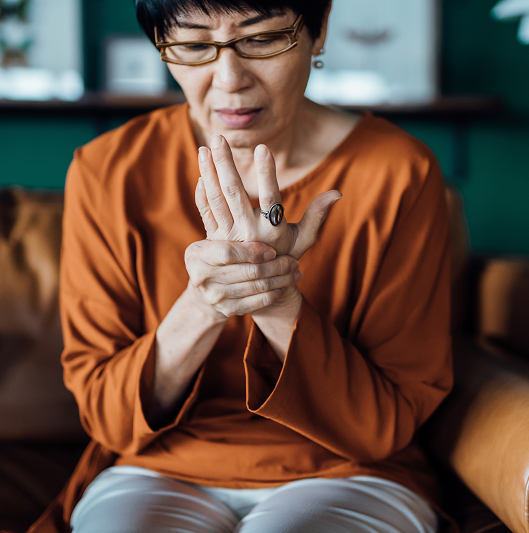
- Diagnosis: Linda Lordi Cavanaugh developed severe arthritis in her hands, which made it difficult to hold a pen or make a fist.
- Treatment: She received LDRT at Jersey Shore University Medical Center, and now she is virtually pain-free.
- Get Care: If you’re experiencing arthritis pain, schedule a rheumatologist appointment: Book online | 800-822-8905.
Medically reviewed by Timothy Chen, M.D., radiation oncologist, Hackensack Meridian Jersey Shore University Medical Center.
Retired attorney and judge Linda Lordi Cavanaugh, 74, of Spring Lake Heights, was caught off guard by arthritis in her hands.
“What’s amazing about arthritis is how much pain and discomfort you can get from one little joint — it can be devastating,” she says.
The soreness started creeping up on her decades ago and gradually made everyday actions like holding a pen hard. “I had difficulty knocking on a door because I can’t really make a fist,” she says. Her hands would cramp on the steering wheel if she was driving for a long time.
As her discomfort grew, she tried over-the-counter pain relievers and prescription medication. But she didn’t want to rely on these medications indefinitely.
Eventually, she was referred to Timothy Chen, M.D., a radiation oncologist and medical director of the Central Nervous System Program at Jersey Shore University Medical Center, to discuss an innovative treatment called low-dose radiation therapy (LDRT).
What Is LDRT?
LDRT has been used in Europe for many years but is newer to the United States. The radiation’s anti-inflammatory effect helps ease pain and swelling for people with arthritis.
It uses a very small, targeted dose of radiation: less than 5 percent of the dose someone might receive during cancer treatment and just slightly higher than the dose in a dental X-ray, Dr. Chen says. This means the noninvasive procedure has virtually no side effects.
Dr. Chen began providing LDRT at Jersey Shore in 2024. He considers it an exciting option for people with osteoarthritis who want longer-lasting results compared to treatments like medications or steroid injections, or who want to delay or avoid surgery. So far, research suggests pain relief from LDRT can last for months or even years, and it can be repeated if needed, he says.
“I’m not here to replace surgery, just provide another option. There are cases where people need surgery, but not every joint is replaceable,” Dr. Chen says. “Plus, from orthopedic literature, we know not everyone who qualifies for surgery makes it to the surgical table, so that means we need to look for alternatives.”
Oncology departments all over the country have the technology to perform this procedure, but not many are using it to treat arthritis yet, he says. “Almost everybody can do this, but they have to know how to do this and how to select the right patients,” he says. “A lot of doctors, even radiation oncologists, don’t even know this treatment exists.”
Linda’s LDRT Experience
Linda warmed up to Dr. Chen right off the bat. “He is a lovely man, and he’s very positive,” she says. “I was struck by his honesty. He was very clear: ‘I cannot cure it, I can’t tell you it will last forever, but I will make it better,’” she recalls.
With his encouragement and transparency, Linda was ready to try LDRT. The treatment consisted of six sessions over two weeks, three times a week.
Before the first, the care team made custom molds to hold Linda’s hands still and in position. At each session, she lay back with her hands in the molds while a machine delivered a low, targeted dose of radiation to her joints, with no needles or anesthesia involved.
“You don’t feel anything at all. You just sit there, and you get zapped a little bit and you go home,” Linda says. Each session took only a few minutes, and she had no side effects.
Plus, her care was top notch. “At the hospital, everyone was lovely,” she says.
Her relief wasn’t immediate, although for some people, it can be. But as her pain eased over the next month or two, the results became profound.
“There was barely a moment I could remember before this that I didn’t have some pain somewhere in my hands,” she says. “But there are moments now when I don’t have any pain at all.”
Before treatment, she had to be extra careful using a knife because she couldn’t get a tight enough grip. After, she was able to cook an entire Thanksgiving dinner.
Dr. Chen remembers the firm handshake she gave him during the second week of treatment; it was much stronger than she’d managed before. “I said, ‘Whoa, that’s a little bit painful with your firm grip now,’” he says.
Long-Lasting Results
Linda understands from talking with Dr. Chen that her improvements may not last forever, and she’s prepared if the day comes when severe pain returns. “I would do it again if I had to,” she says.
So far, Dr. Chen’s longest case has been benefiting from LDRT for 19 months and counting. “We are very optimistic so far,” he says.
People who have already had a joint replacement surgery may not be the best candidates for LDRT, Dr. Chen says.
If you’re curious to learn more, talk to your primary care physician or rheumatologist about getting a referral to a radiation oncologist, especially if other treatments haven’t helped or caused unwanted side effects. He believes in this procedure so much he even performed it on his own mother and father-in-law.
Linda encourages others to consider LDRT for their arthritis. “It is certainly worth exploring,” she says. “My experience, from day one to today, has been very positive.”
Next Steps & Resources:
- Meet our source: Timothy Chen, M.D.
- Learn more about our rheumatology services.
Find a doctor near me

3 Common Causes of Hand Pain Without Injury
8 Foods That Help Reduce Inflammation and Ease Arthritis Pain

Thumb Arthritis: Splints, Braces and Pain Relief