

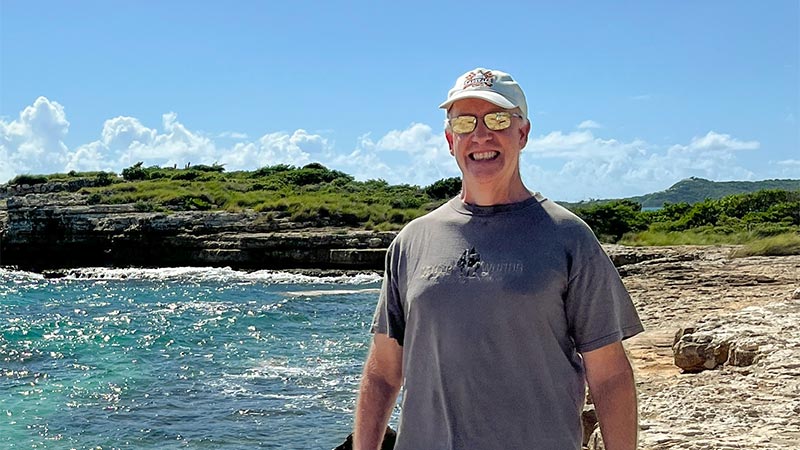
In September 2024, Eric Lewanda, a retired chemist from Olney, Maryland, got a routine prostate cancer screening. The 62-year-old had been screened regularly since he was 50, but this time the test detected cancer.
Prostate cancer ran in his family. His brother passed away from the disease, so even though Eric had no symptoms, he knew he couldn’t hesitate to act.
He and his wife, a physician, started meeting with local surgeons to find the right fit for his prostatectomy, which is a type of surgery that removes all or part of the prostate gland. His scientific mind and her medical expertise helped them ask sharp questions and weigh their options carefully.
None of the surgeons near their home felt like the right fit, but one of them mentioned he’d trained with a world-renowned oncology surgeon at Hackensack University Medical Center in Hackensack, New Jersey: Mutahar Ahmed, M.D.
Eric reached out to him right away.
A Less Invasive Prostate Cancer Surgery
Dr. Ahmed explained that for Eric, a standard prostatectomy wasn’t an option. Prior abdominal surgeries had left scar tissue that made the traditional multi-incision approach unsafe.
Because of this, Eric moved forward with a single-port robotic prostatectomy. This minimally invasive technique allowed Dr. Ahmed to operate through one small incision instead of several, letting him reach and remove the prostate while working around Eric’s scar tissue. The technique also results in less pain, fewer scars and a faster recovery.
Dr. Ahmed is a pioneer and global educator in the single-port robotic procedure. “Very few people do this in the United States,” he says. “We’re one of a handful of places, and almost every week I’m teaching it to other surgeons.”
Eric knows how rare it is to find a surgeon who can perform the procedure: “From what I understand, there's probably as many surgeons who do this as fingers on your one hand,” he says.
The surgery, which took less than an hour, was a success, and Eric went home the next day.
The Road to Recovery
Within 24 hours of the surgery, Eric was off prescription pain meds and able to get up and walk around. He logged a tenth of a mile at first and a full mile by day seven.
He also was able to retrain bladder control within six weeks — much quicker than with traditional prostate surgery, which can take three to six months. Dr. Ahmed says preserving urinary control and erectile function is a priority whenever the prostate is removed, and patients tend to regain those functions faster with the single-port approach.
Because Dr. Ahmed could work through external scar tissue from earlier surgeries, the incision he left was less than an inch long and barely visible. “You can't tell that I've had this surgery,” Eric says. “Dr. Ahmed used the road that was already mapped right there exteriorly.”
That fits how Dr. Ahmed approaches his work. “My most important goal is controlling the cancer,” he says. “But if I can get rid of the cancer in the most minimally invasive way with a quicker recovery, why not? We want to cure the cancer and give you the fewest side effects.”
The Importance of Advocating for Yourself
Eric wouldn’t have found Dr. Ahmed if he hadn’t focused on asking the right questions. Because of this, he encourages anyone facing prostate cancer surgery, or any surgery, to ask doctors: “How long have you been in practice? And how many of these have you done?”
“At first, I was hesitant to ask that because I felt it was rude,” he says. “And then I said, ‘You know what? This is my life. I'm asking.’”
Eric says choosing a surgeon is the same as hiring someone for a job: “You want them to be properly credentialed, you want them to have proper experience, and you want them to have good referrals.”
He also encourages other patients to ask what to expect after treatment. “Make sure you understand what you are getting into,” he says. “It helps you mentally prepare, and it helps your family prepare.”
Dr. Ahmed sees patient education the same way. He often draws diagrams for patients during consultations to walk them through what the surgery involves and what recovery looks like. When people understand the plan, they’re better prepared for the road ahead, he says.
Since his surgery, Eric and Dr. Ahmed have had two follow-up visits by phone to discuss his recovery and go over his most recent blood tests. Eric feels comforted by Dr. Ahmed’s compassionate approach and never feels rushed.
“You can talk to him on a human level,” he says. “I feel good after I hang up the phone.”
As long as he stays cancer-free, his check-ins will stretch further apart. An avid hiker, Eric had surgery in June 2025 and was still able to go on the hiking trips he had already planned for that fall.
Today, he feels “as if I never had surgery at all.”
Next Steps & Resources
- Meet our source: Mutahar Ahmed, M.D.
- Make an appointment online with a urologist near you, or call 800-822-8905.
Learn more about our urology services.

Are You at Risk for Prostate Cancer?
Reduce your prostate cancer risk. Learn about screenings, risk factors, and expert advice from Drs. Garden and Agarwal. Schedule an appointment today.
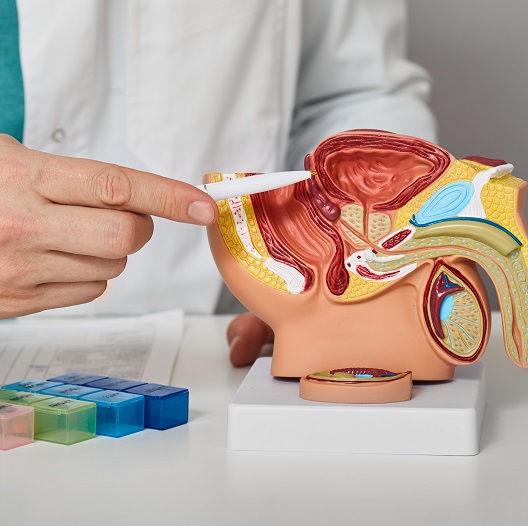
6 Signs of Prostate Problems and What They Could Mean
When should prostate changes cause you concern, and what could they signal? Our expert weighs in.

Why is Prostate Cancer on the Rise?
Rising prostate cancer rates explained. Dr. Wheeler shares insights on prevention and screening. Protect your health; schedule your appointment today.
Robotic Surgery Gets the Job Done after Prostate Cancer Diagnosis
Robotic surgery provided great results with minimal complications for Scott Bamford, 52, after an unexpected prostate cancer diagnosis at a young age.