

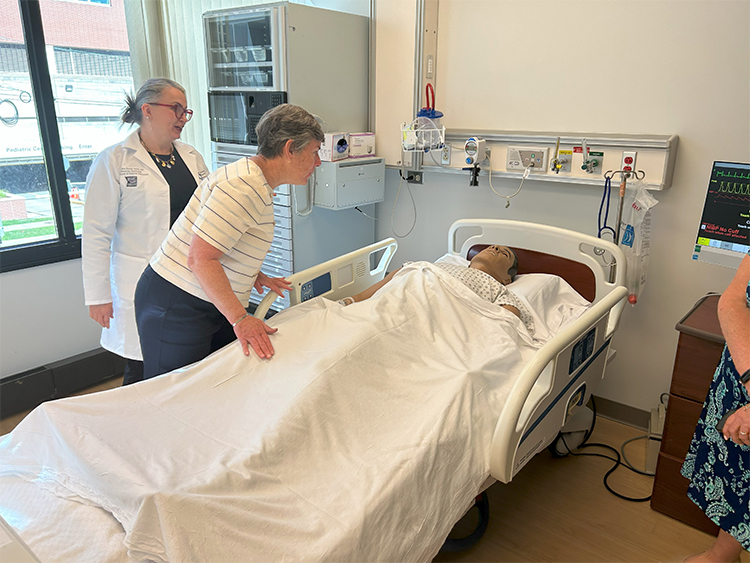
When nurses find themselves in critical situations, such as when a patient’s heart stops or a newborn suddenly struggles to breathe, competency and confidence can make a world of difference. Thanks to the new Nursing Professional Development Simulation Lab — or “Sim Lab” — at Hackensack University Medical Center, nurses now have a state-of-the-art training ground to master these skills in a safe space.
When Pam Pascarelli, DNP, RN, NPD-BC, CCRN, learned that her hospital’s annual golf outing would help support this training, she was overjoyed.
“I don’t have words for it,” she said. “It’s something we never imagined would be possible.”
Overhauling Nurse Training at Hackensack University Medical Center
Pam, who serves as the manager of nursing professional development at Hackensack University Medical Center, has worked at Hackensack for nearly 45 years. For a significant portion of that time, nurses were taught in the classroom with low-fidelity task trainers to practice their skills. The task trainers — such as a plastic abdomen, an arm or a chest — were used to practice medical tasks such as IV insertions, chest tube care, central venous access care and colostomy care. Pam says these task trainers are useful, but they have their limits.
“Nursing students were coming from advanced simulation labs in school, and we wanted to ensure their learning progression was seamless,” said Pam. “As educators, we knew we could provide a more continuous and advanced training environment if we had a high fidelity simulation lab.”
What the “Sim Lab” Provides for New and Veteran Nurses
The “Sim Lab” — which nurses have been utilizing since January — consists of two realistic, high-fidelity medical manikins. One adult and one newborn manikin sit alongside bedside monitors that mimic a patient’s vital signs and condition. The lab, which sits in a small space that was previously used for storage, looks similar to a standard hospital room. A control room is hidden behind one-way glass that allows an educator to create situations and observe how a nurse reacts. Pam says the “Sim Lab” provides “a level of realism that makes all the difference.”
“Before, we had to verbally prompt the nurse to imagine a change. Now, they see it happen live on the monitor. This challenges them to assess the situation and react on their own, rather than simply following our verbal cues."
More than 1,000 Nurses Actively Benefit from Simulation Lab
By Pam’s count, nearly 1,500 nurses use the “Sim Lab” on a regular basis to sharpen their life-saving skills and build confidence. Some areas of emphasis include rapid response and newborn resuscitation, and the exercises — along with the debriefings that follow — allow incoming nurses to build confidence, while helping experienced nurses maintain their competencies.
“This is helping nurses, but ultimately, we’re preparing those nurses to be better prepared to take care of all of our patients in the hospital,” she said. “That’s the ultimate goal.”
"It's extremely gratifying to see that the Nursing Simulation Lab is having an immediate effect on our nurses, and ultimately our patients, at Hackensack University Medical Center," said Richard Knupp, vice president of Academic Hospital Development at Hackensack Meridian Health Foundation. "I want to thank our family of donors and our sponsors for making our annual golf outing such a tremendous success, and for helping us provide cutting-edge training for our nurses and better patient outcomes at Hackensack."
Pam is immensely grateful for the donors and sponsors who made the golf outing such a success. She credits their generosity for helping to provide invaluable training for Hackensack’s nurses and better care for Hackensack’s patients.
“I never thought that something like this was even a possibility,” she said. “I think we all are forever grateful. There aren’t words for it.”
To learn more about how you can support the life-saving work at Hackensack University Medical Center, visit GiveHMH.org/HUMC.

Single-Port Robotic Surgery Makes Complex Surgeries Possible With One Small Incision
Learn how Hackensack Meridian Health surgeons are pioneering a one-incision method to perform complex, life-saving surgeries.

Firing on All Cylinders After Knee Replacement
Recover fully from knee replacement. Learn about robotic surgery with Dr. Kayal at Pascack Valley Medical Center. Schedule your appointment today.

New Minimally Invasive Procedure Used to Repair Woman’s Life-Threatening Aneurysm
When Cecelia Lucas learned she would need surgery to repair a dangerous aneurysm in her chest, she thought she was facing a long and painful recovery. Fortunately, a new minimally invasive procedure allowed her to have the repair with a much shorter recovery time.
3 Advances in Joint Replacement Surgery
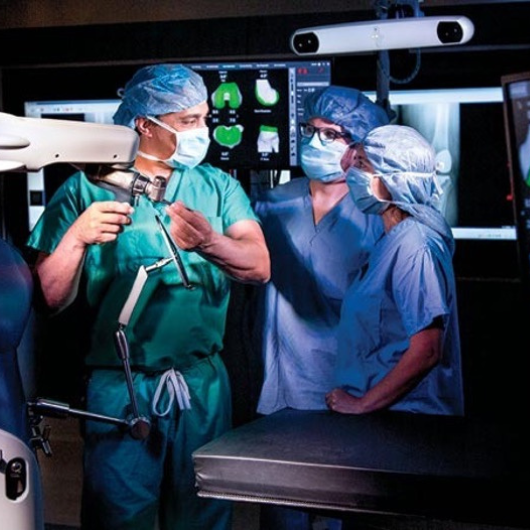
From AI-guided hip replacement surgery to robotic knee replacement surgery, learn about three technologies changing how doctors treat joint pain.