

Key Takeaways
Hackensack Meridian Health surgeons used 3D printing to create custom implants to repair Matthew Polaski’s skull after a catastrophic fall.
- Diagnosis: Matthew Polaski fell from a third-floor balcony while vacationing with family, causing severe brain trauma and ultimately requiring skull reconstruction.
- Treatment: HMH surgeons performed the skull reconstruction through Matthew’s existing incisions as a single procedure.
- Get Care: Do you or someone you love need neurosurgery? Consult a neurosurgeon: Book online | 800-822-8905.
Medically reviewed by Nitesh V. Patel, M.D., Neurosurgical Oncologist, Hackensack Meridian Jersey Shore University Medical Center
The Polaski family, from Point Pleasant, NJ, always enjoyed spending time together over winter break in the sunshine of Punta Cana, Dominican Republic. But on December 28, 2025, their vacation quickly turned into a nightmare. Stephanie and Michael Polaski received a frantic call from the hotel that their son, Matthew, a freshman at the University of Alabama, had fallen from a third-story balcony.
The impact of the fall shattered both sides of Matthew’s skull. He was taken to a local hospital, where the prognosis was not good. "They had us say our goodbyes to him because they did not think he would make it," his mother Stephanie says.
Following emergency surgery to remove part of his skull so there was room for his brain to swell, Stephanie flew with a comatose Matthew to a trauma center in Miami. After seven days in a coma, Matthew woke up. He was paralyzed on his left side and had fractures to his spine, pelvis and left orbital. Just 14 days later, he was transported via medical jet to a rehabilitation center in New Jersey. He amazed doctors and his family when he walked out on his own, two weeks later.
The final piece of his recovery was a complex cranial reconstruction surgery. Fortunately, he was able to have the procedure close to home at Hackensack Meridian Jersey Shore University Medical Center.
Custom 3D Printed Implant
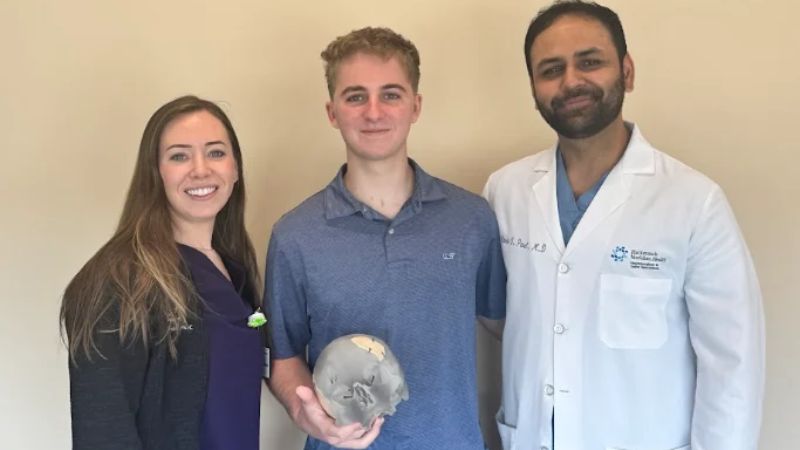
Rebuilding Matthew’s skull was not easy. Neurosurgeon Nitesh V. Patel, M.D., director of the Neurosurgical Oncology Program, and plastic surgeon Chrisovalantis Lakhiani, M.D., used custom 3D-printed implants to ensure the missing portions of Matthew’s skull were replicated perfectly.
While it’s standard practice to use 3D-printed implants when a portion of the skull is no longer viable due to trauma, surgery or infection, Dr. Patel says Matthew’s case was unique. “Matthew's case was special because there were missing portions on both sides of his skull and it involved an incredible journey,” he says.
Dr. Patel used high-resolution CT scans of Matthew’s head to get the precise dimensions of the missing areas of his skull. Software was then used to create a digital model of Matthew’s entire skull and to reconstruct the missing pieces. A specialized 3D printer built the necessary pieces using medical-grade material.
According to Dr. Patel, the use of 3D implants is changing the way that surgeons like himself approach surgery. “In the past, we wouldn’t necessarily have a solution that would allow patients like Matthew to return to their normal lives. Being able to recreate an exact replica of missing pieces is a game-changer,” he says.
Compassion and Innovation
Although both sides of Matthew’s skull needed reconstruction, Dr. Patel and Dr. Lakhiani were able to perform a single-stage procedure, so he would not have to undergo anesthesia twice. Matthew was also happy to learn that he would not have to shave his head for the surgery. In fact, Dr. Patel requested that Matthew let his hair grow out prior to the procedure.
Dr. Patel took an innovative approach to the surgery, carefully parting Matthew's hair along his existing incision lines to avoid having to reshave his head and creating new scars. It was a considerate act that meant the world to the young patient.
"He just gets it," Stephanie said of the neurosurgeon's thoughtfulness. "Matthew spent months recovering and adjusting to his new appearance. Dr. Patel recognized this and had the patience and compassion to make every effort to avoid setting Matthew back by shaving his head again and exposing the incisions."
Returning to School
Today, with little visible evidence of his ordeal, Matthew is back at the University of Alabama with a full 17-credit course load. Even his doctors are amazed by his near-complete cognitive recovery and his spirit. "His story is a powerful example of resilience, multidisciplinary care and the impact of strong family support," said Dr. Patel.
Matthew credits Dr. Patel and the team at Jersey Shore for their innovative approach to helping him return to a normal college life. He even brought something with him to college to remind himself of how far he has come: a skull, complete with copies of the 3D-printed pieces implanted into it and signed by the whole team.
He plans on making the most of his life and recovery. "I'm not lucky to be alive, I'm supposed to be alive," he says.
Next Steps & Resources
- Meet our sources: Nitesh V. Patel, M.D., and Chrisovalantis Lakhiani, M.D.
- Learn more about neurosurgery at Hackensack Meridian Health.
Back to School: Individualized Approach to Brain Injury Rehabilitation
Brain injury rehab: Personalized care. Recover & return to life. Learn Kajal's story & find expert help. Call 800-822-8905.
25-year-old Man on the Road to Recovery After a Debilitative Brain Injury
Brain injury recovery story: 25-year-old Michael's journey to regaining independence after a debilitating injury at Jersey Shore University Medical Center and JFK Johnson Rehabilitation Institute. Learn more.
4 Steps to Recovery After a Brain Injury
Recover from a brain injury. Dr. Greiss offers 4 steps to recovery and support at JFK Johnson Rehabilitation Institute. Call 800-822-8905.

Should You Let Your Child Sleep if You Suspect a Head Injury?
Head injuries can be frightening, especially in children, so it’s important to know what to do if and when they happen. Even if you think it’s just a bump on the head, pay attention to your child’s cues.