

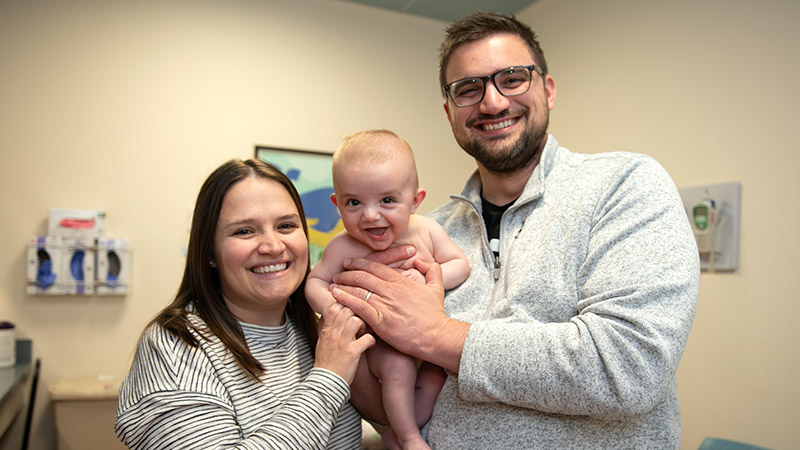
Until the 22-week mark, Katie and Matt Moser’s pregnancy had been uneventful.
But at a routine doctor’s visit, everything changed. An ultrasound showed that the bowel of their unborn son, who they planned to name Ryan, was dilated and that fluid had developed around his abdomen. It wasn’t clear from the ultrasound what was causing the issues, and their doctor said they wouldn’t have answers until Ryan was born.
“We were completely blindsided,” says Katie. “We had gone in two weeks before, and everything was perfect.”
It was the beginning of a journey the Mosers never anticipated, one that would include emergency surgery for their son at just 7 hours old, nearly two months in the NICU and a care team that Katie says saved her son’s life.
The Monmouth County, New Jersey, family had already been through one complicated delivery with their first son, Kyle — he stopped breathing after delivery and was admitted to the NICU at K. Hovnanian Children’s Hospital at Jersey Shore University Medical Center for a week. They’d been hoping for an ordinary birth with Ryan.
Finding the Right Care Team
Katie’s maternal fetal medicine team connected her to the Healthy Beginnings Program, which coordinates care for high-risk pregnancies and prepares families for a potential NICU stay.
Within days, Katie and Matt were meeting with a team of specialists, including pediatric surgeon Margaret McGuire, M.D., who told the Mosers that Ryan would likely need surgery at birth and that her team would be ready.
“They said, ‘We can take care of you here. We’ve got it,’” Katie recalls. “It was honestly such a sense of relief.”
For the next 14 weeks, Katie received weekly ultrasounds and close monitoring. The plan was to induce her by 39 weeks at the latest.
But baby Ryan had other plans. At 36 weeks, Katie went into labor in the middle of the night. When his heart rate climbed during delivery, the doctors performed an emergency cesarean section.
Emergency Surgery at 7 Hours Old
Ryan wasn’t breathing when he arrived. The NICU team had to resuscitate him immediately, and within the first hour, X-rays revealed a blockage in his intestine.
“We knew that Ryan was struggling from the moment he was born,” says Mark Kayton, M.D., chief of Pediatric General Surgery at K. Hovnanian Children’s Hospital, who was the surgeon on call that night. “We did not expect him to survive without going to surgery.”
Dr. Kayton met with Katie and Matt and explained what needed to happen. Although Katie was still groggy from the C-section, she remembers one thing clearly: “Dr. Kayton said, ‘Your body kept him alive.’ That meant everything to me,” she recalls.
During surgery, Dr. Kayton discovered that a congenital condition called Meckel’s diverticulum had caused part of Ryan’s intestine to twist, cutting off blood flow. A third of his intestine had to be removed. His digestion was temporarily rerouted to an ostomy bag, and his abdomen was left open for two days until the swelling subsided enough to close it surgically.
A Long Road in the NICU
Ryan spent the next several weeks in the Level III NICU, where feeding was a constant challenge. Everything he took in passed straight through his shortened intestine without being absorbed.
The doctors were concerned that Ryan would become dehydrated, so they called in pediatric gastroenterologist Brittany Parlow, M.D., to help.
“We switched Ryan to a formula that was very broken down, to allow him to better absorb it,” says Dr. Parlow. That ultimately helped Ryan retain the nutrients he needed to thrive.
But he still had a long road ahead of him. He would need around-the-clock care for the next several weeks.
“Someone was with Ryan from 9 a.m. to almost 10 p.m.,” Katie says. “The NICU was his home for the first two months, and they took good care of him.”
Some of the nurses even recognized the Mosers from their first son Kyle’s NICU stay years earlier. “They remembered Kyle,” Katie says. “So, it was kind of special to show them pictures of how amazing he’s doing.”
After five weeks, Ryan was strong enough for Dr. Kayton to reconnect his intestine. During the procedure, Dr. Kayton noticed the remaining intestine had already undergone hypertrophy, a supercharged growth process in which the body compensates for lost tissue. It was a sign of rapid recovery. Four days later, Ryan was taking a bottle.
A Christmas Miracle
On December 27, 2025, 53 days after he was born, Ryan was discharged from the NICU to great fanfare.
“They played graduation music and did a parade,” says Katie. “It was really special.”
Dr. Kayton agrees: “He was our Christmas miracle.”
Now 5 months old, Ryan is meeting all his milestones and has even started solid foods. “We thought we were going to have this really tough journey, and we were prepared for it,” says Katie. “But Ryan’s a normal baby. He eats and poops and does everything a normal baby does.”
Dr. Kayton and Dr. Parlow will continue monitoring Ryan throughout his childhood. “Although we call our program Healthy Beginnings, it’s really not just for the beginning,” says Dr. Kayton. “As Ryan’s surgeon, I told the family I want to keep track of him until high school.”
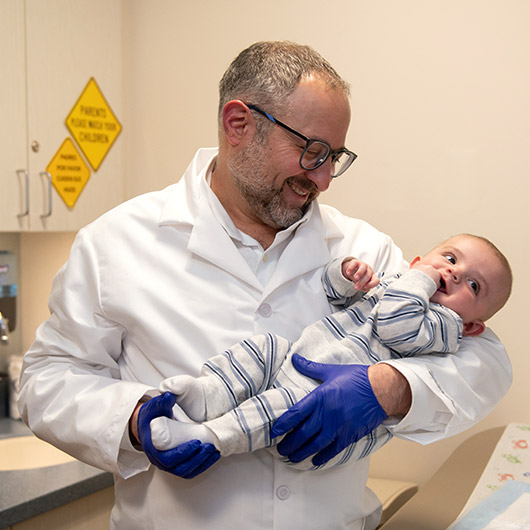
Image: Dr. Kayton and baby Ryan.
The Mosers credit the care team at Hackensack Meridian Health for saving their baby. But Dr. Kayton says inspiration goes both ways.
“These parents were the bravest of the brave,” he says. “They never wavered in their resolve and their optimism. The family was an inspiration to the people who cared for them.”
Next Steps & Resources
- Meet our sources: Margaret McGuire, M.D., Mark Kayton, M.D. and Brittany Parlow, M.D.
- Make an appointment online with a maternity care specialist near you, or call 800-822-8905.
- Learn more about maternal fetal medicine care for high-risk pregnancies.

From the NICU to Thriving at Home
NICU to thriving at home: Owen's story at Pascack Valley Medical Center and Hackensack University Medical Center. Learn how expert care helped. Call 800-822-8905.

Having a Baby When You Have MS: Your Medication Safety Guide
Can you have a healthy pregnancy with multiple sclerosis? Learn how to safely manage MS medications during pregnancy, reduce risks and navigate breastfeeding with expert medical advice.
What Happens to Your Hormones After Birth?
Postpartum hormone changes explained by Drs. Gerardis & Kopp. Understand the shifts, their effects, and how to cope. Learn more & schedule an appointment.

Mammograms During Pregnancy: Safe and Effective
You don't need to delay your mammogram if you're pregnant or breastfeeding. Our breast cancer specialists discuss why mammograms are safe and important.