

Key Takeaways
- You can still have a healthy pregnancy and birth if you’ve been diagnosed with a high-risk pregnancy. It doesn’t mean things will go wrong—it means your care team will keep a closer eye on you and your baby.
- You may need to have more appointments with your doctor for monitoring, and you may need to adjust your birth plan.
- If your pregnancy is high-risk, it’s important to see a maternal-fetal medicine (MFM) specialist. Make an appointment online with an MFM specialist near you, or call 800-822-8905.
Written By: Karen Kostich, BSN, RN C-EFM, nurse manager, Maternal Child Health, Riverview Medical Center
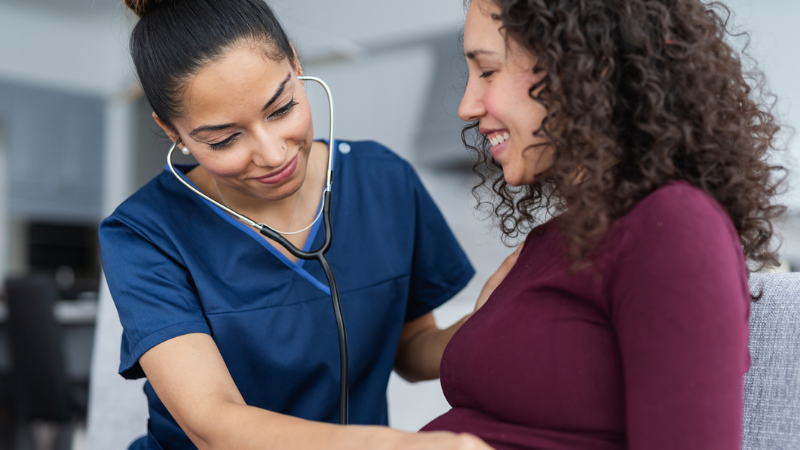
If you’ve been told your pregnancy is high-risk, you probably have a lot of questions.
As a nurse manager in maternal child health, I’ve cared for many families through complicated pregnancies, and I know how scary those words can feel. But the diagnosis can also be reassuring: It means you’re getting extra attention and top-notch care.
Here’s what I tell my patients about having a high-risk pregnancy, including how to prepare for birth and why it’s important to prioritize self-care.
1. There’s a higher-than-average chance that you and/or your baby may develop health issues.
You can be diagnosed with a high-risk pregnancy for many reasons, including age. If you’re age 35 or older, which describes many of our pregnant patients at Hackensack Meridian Health, your OB-GYN may consider your pregnancy high-risk.
Other risk factors include carrying multiples, a past pregnancy problem like premature delivery, or a condition that develops during pregnancy, such as preeclampsia or gestational diabetes.
2. You and your baby will need extra monitoring.
With a high-risk pregnancy, your OB-GYN will keep a closer eye on you and your baby. This means you’ll have more frequent doctor appointments and extra ultrasounds to make sure that any conditions are managed and that your baby is growing well. That extra attention can be really reassuring.
3. You may need to adjust your birth plan.
A birth plan is a wonderful thing, but there’s no guarantee that you’ll be able to stick to it. Stay open-minded and flexible in case your OB-GYN recommends an earlier induction or cesarean section (planned or emergency) for your safety or your baby’s.
As your pregnancy progresses, talk to your OB-GYN about what’s realistic for your birth plan. Remember: The goal, in the end, is a healthy you and a healthy baby.
4. You may want to prepare for the possibility of a NICU stay.
If your pregnancy is high-risk, learning a little about theneonatal intensive care unit (NICU) ahead of time can feel empowering rather than frightening. A NICU stay might be needed if your baby arrives early, has trouble breathing or needs specialized care for other reasons.
Knowing it’s a possibility doesn’t mean it will happen, but understanding the NICU can ease a lot of anxiety. At Riverview Medical Center, our level II NICU has neonatologists, pediatricians, specially trained nurses, and case managers and social workers who are available around-the-clock. Many of us have had our own children in the NICU, so we understand exactly what you’re going through.
5. It’s important to prioritize self-care.
Self-care isn’t selfish. It’s essential. A high-risk pregnancy can be emotionally and physically taxing, so focus on what you can control, because there’s a lot you can’t.
Get good sleep, take light walks, drink plenty of water, make time for things you enjoy and build a strong support system of people who will show up for you. Taking care of yourself is the best thing you can do for your baby.
The Bottom Line
The biggest thing I want you to know is that you can still have a healthy pregnancy and birth when your pregnancy is high-risk.
It doesn’t mean things will go wrong. It means your care team will simply be more watchful. Often, that makes the whole experience a more positive one.
Next Steps & Resources:
- Learn more about our maternal-fetal medicine services at Hackensack Meridian Health.
Find a doctor near me
4 Ways You Can Help NICU Parents
Support NICU parents. Learn 4 ways to help from Joseph M. Sanzari Children's Hospital doctors. Offer practical and emotional support.
Preemie Overcomes Feeding Challenges in JFK’s NICU
“It was hard going into the hospital every day and not taking our newborn daughter Emma home every night, but the nurses made us feel so much better about every aspect of it. In addition to practicing great medicine, they were the kindest people. They held Emma like she was their own.” — Annmarie Butare, Lebanon, N.J.

8 Foods and Beverages to Avoid During Pregnancy
Avoid harmful foods during pregnancy. Dr. Rajpal identifies 8 foods and drinks to eliminate for a healthy pregnancy. Learn what to avoid and protect your baby's health. Call 800-822-8905.

How to Prepare for an Unmedicated Birth
Prepare for an unmedicated birth. Learn techniques from certified nurse-midwife Eva Bane at Mountainside Medical Center. Find a provider and plan your birth.