

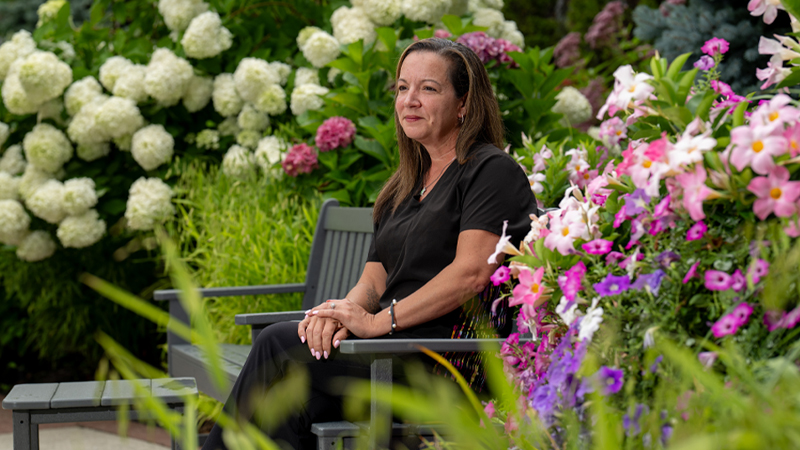
“Scary. Definitely, scary.”
That’s how Maureen D. describes the moment her first colonoscopy turned serious in December 2025.
After she turned 50, the Jackson resident, who works at Jersey Shore University Medical Center as a monitor tech, had scheduled the routine screening with gastroenterologist Kenny Hui, M.D. She expected to just check the box for getting it done.
Instead, the colonoscopy revealed a large polyp that couldn’t be removed during the screening procedure. After a few long weeks, pathology confirmed it was a precancerous colon polyp, the kind that can eventually turn into colon cancer if left alone.
Her family history made the diagnosis hit closer to home. Her father had recently been diagnosed with colon cancer, and her grandmother had died of the disease years earlier.
On Dr. Hui’s recommendation, she followed up with colorectal surgeon Glenn Parker, M.D. for treatment.
Deciding on Surgery
Maureen felt at ease with Dr. Parker right away, in part because she’d once worked in his office.
“He never made me feel intimidated,” she says. “He always answered my questions. He’s all about teaching and explaining everything, so I knew I was in good hands.”
Because the polyp was too big to remove during the colonoscopy, the next step was a surgery called a right hemicolectomy, which would remove the affected part of the colon. (When a growth can’t be taken out through the scope, that section of the colon must come out.)
“It’s really treated as an oncologic or cancer operation regardless, just in case the final result comes back as cancer,” Dr. Parker says.
Hearing that, “I was absolutely terrified,” Maureen says. “I worried about needing a colostomy bag.”
But Dr. Parker walked her and her boyfriend through exactly what to expect and answered every question, which put them both at ease.
A Minimally Invasive Robotic Procedure
Before her surgery, Maureen went in for preadmission testing. The receptionist, the nurse and the anesthesiologist were all kind, thorough and patient with her questions.
“Their plan of treatment was just phenomenal,” she says.
In March 2026, Dr. Parker performed a minimally invasive robotic procedure, which uses smaller incisions than traditional open surgery, to remove the right side of Maureen’s colon.
The minimally invasive procedure results in less pain and a quicker recovery, he says. It also helps patients get up and moving sooner, which supports healing.
The morning of the operation, Maureen remembers telling her boyfriend she loved him and kissing him goodbye. The next thing she knew, she was waking up in recovery, relieved that she never even saw the operating room.
Her fear about a colostomy bag never came to pass. “You can’t even tell that I had surgery on my stomach,” she says. “The incisions look like scratch marks.”
A Faster-Than-Expected Recovery
Maureen thought she would need to spend a week in the hospital to recover. But she went home in three days.
She credits her care team for getting her up and walking right away. “I was like, ‘Yes, let’s go!’ and really pushed myself to walk the hallways,” she says.
One night, a nurse spent 15 minutes massaging her shoulder to ease pain that had made it impossible to sleep on that side. “The nurses treated me not just like a patient, but like family,” Maureen says.
That care meant even more to her because Jersey Shore is her own hospital. Maureen works there, and she was born there, too.
Seeing the team treat her the way she sees them treat others left her feeling proud of where she works. “I just know this is how they are with every patient,” she says.
Now 51, Maureen will see Dr. Parker every two months for the next year; then, she will have a follow-up colonoscopy in March 2027.
If everything looks clear, she’ll return to screening every few years.
The Power of Early Screening
Most people should start colorectal cancer screening at age 45, Dr. Parker says. But if you have symptoms like rectal bleeding, see a doctor right away, no matter your age.
And if a first-degree relative (a parent, sibling or child) has had colorectal cancer, you should start screening 10 years before the age at which they were diagnosed or at age 40 — whichever comes first.
Maureen had no symptoms before her diagnosis.
“You hear of people who push off getting their colonoscopy until it’s too late,” she says. “But if I hadn’t had this screening done, I don’t know what would have happened. If your doctor says go for your screening, do it.”
Getting a colonoscopy is easier than you might think — the hardest part is the prep, which involves taking laxatives or an enema to clear out your colon.
Next Steps & Resources
- Meet our source(s): Glenn Parker, M.D.
- Make an appointment online with a colon and rectal surgeon near you, or call 800-822-8905.
- Learn more about our gastroenterology services.

Fiber and Colon Cancer Risk: What You Need to Know
Does the amount of fiber you eat have an impact on your colon cancer risk? Research says yes. Explore the details from a specialist in colon and rectal surgery.
Fainting Episode Leads to Shocking Colon Cancer Diagnosis
After passing out at an outdoor summer event, Carin Givens, 50, underwent a battery of tests and screenings that led to his life-saving colon cancer diagnosis and treatment
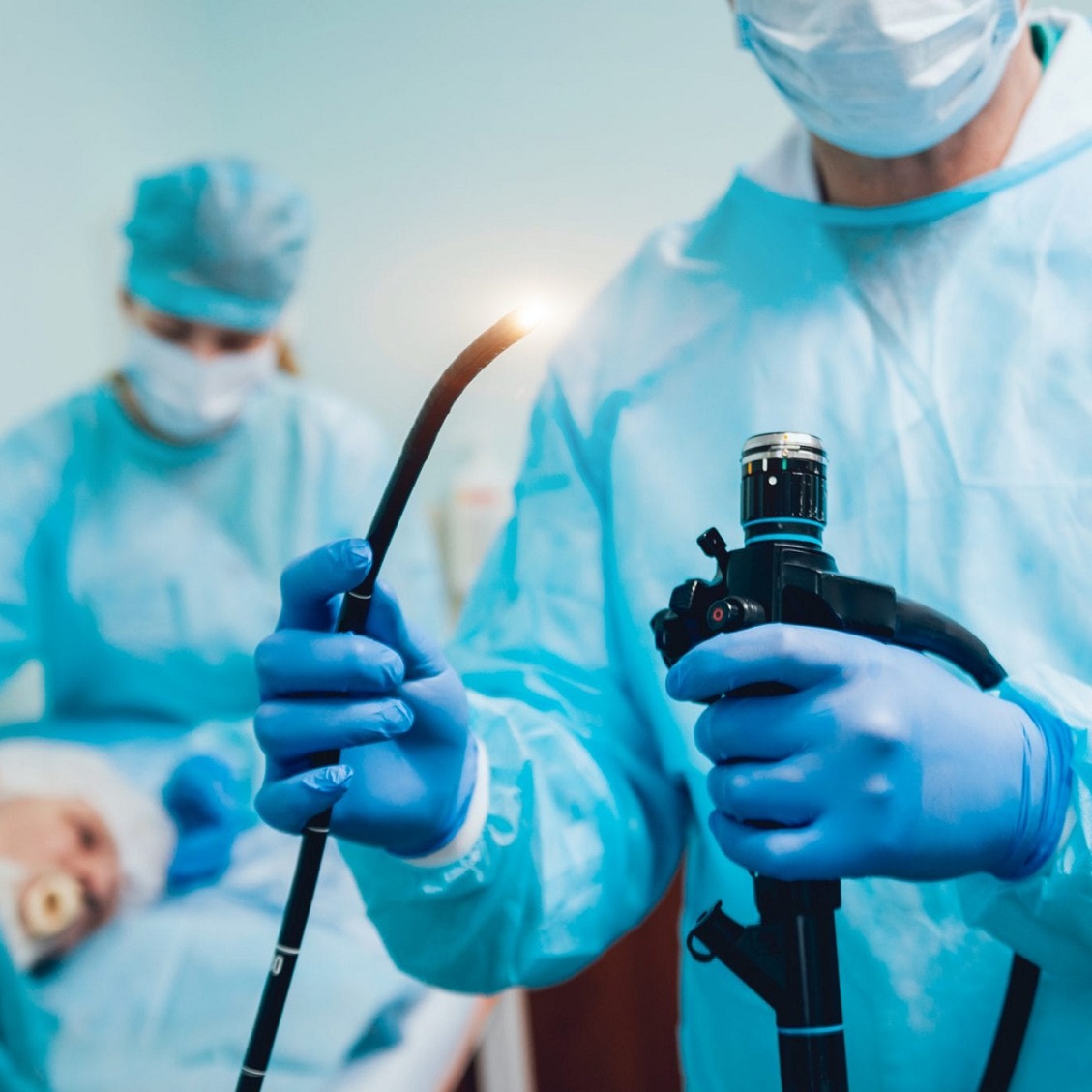
Are Colonoscopies Really That Bad?
Colonoscopy concerns? Dr. Khoo explains the procedure, prep, and recovery. Learn what to expect and ease your worries. Schedule your appointment today.
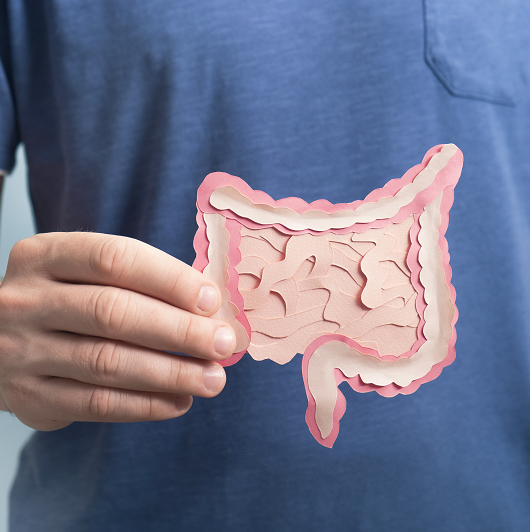
Is Gut Health Linked to Colon Cancer?
Gut health and colon cancer: Learn how your microbiome impacts colon cancer risk and how to improve gut health with simple dietary changes. Call 800-822-8905.