
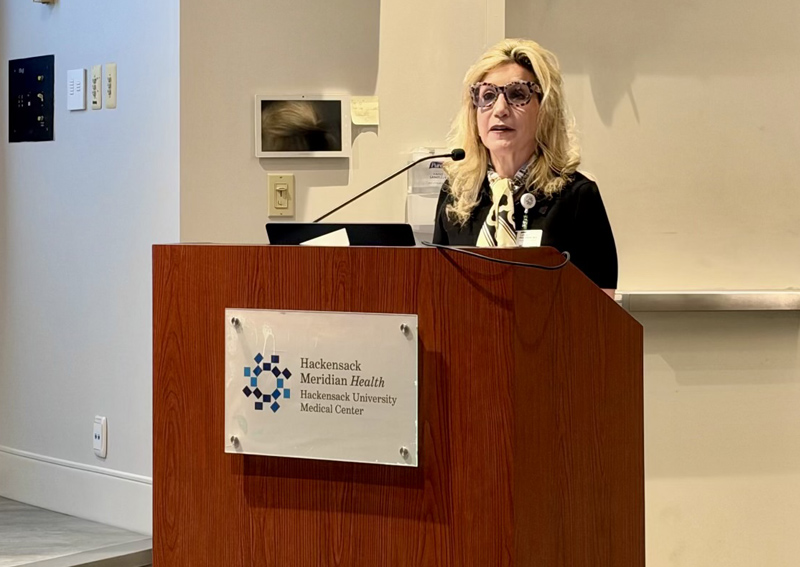
When dealing with acute aortic conditions, every single second counts. It is a devastating reality the nation was reminded of this past summer with the sudden passing of U.S. Senator Lindsey Graham from an aortic dissection. Against this sobering backdrop—and perfectly timed with Aortic Disease Awareness Month and World Heart Day—Hackensack University Medical Center (HUMC) convened its Inaugural 2026 Aortic Center Symposium on September 29.
Operating under the urgent mandate, “Recognize Early. Treat Rapidly. Save Lives,” the symposium drew a collaborative "village" of 160 medical professionals—with 60 gathering in person and 100 logging in virtually.
Led by Lisa Tank, MD, MBA,FACP, President and Chief Hospital Executive of HUMC, alongside clinical leaders including Caron Rockman, MD, FACS, Northern Regional Chair for Vascular Surgery and Chair of the Department of Vascular Surgery at Hackensack University Medical Center; Mark Anderson, MD, MHA, FACS, Chair of the Department of Cardiac Surgery at Hackensack University Medical Center; George Batsides, MD, Chief and Vice Chair of Cardiac Surgery, Surgical Director of Mechanical Circulatory Support, and Co-Director of the Hackensack Aortic Center at Hackensack University Medical Center; and Michael Wilderman, MD, FACS,Chief of Endovascular Surgery and Co-Director of the Hackensack Aortic Center at Hackensack University Medical Center. The event underscored a vital truth: combating aortic disease requires a highly coordinated, multidisciplinary approach that extends far beyond the operating room.
The Silent Crisis and the Diagnosis Gap
Aortic dissections—a tear in the inner layer of the body's largest blood vessel—claim the lives of roughly 13,000 Americans each year. While historically considered rare, diagnosed incidence rates have been steadily rising. This is driven in part by an aging population and increasing rates of arteriosclerotic cardiovascular disease, as well as improved, more frequent medical imaging. Yet, despite these technological advances, clinical misdiagnosis remains a deadly hurdle.
This reality was brought to life by an aortic dissection survivor who openly shared his journey to a diagnosis, recounting how his severe symptoms were initially dismissed by several outpatient practitioners as "back spasms" or simply "stress-related."
Dr. Caron Rockman, a leading vascular expert at HUMC, noted that the patient's story is a critical wake-up call for the entire medical community. “It sends a message about a lack of awareness, even on the part of many medical professionals,” Dr. Rockman explained, emphasizing that breaking down educational barriers is key to catching this potentially lethal problem in time.
Closing the Gap: Inequities in Care
The comprehensive agenda covered a wide spectrum of modern aortic care, including surgical techniques, genetic risk factors, identifying aortic emergencies in the Emergency Department, and managing the disease in women.
Crucially, the symposium did not shy away from the socioeconomic realities of cardiovascular health. The day concluded with a powerful session on health disparities in aortic disease care, which Dr. Rockman highlighted as the most impactful presentation of the day.
"When you look at the effect of socioeconomic disparities, it’s striking to see some of those numbers," said Dr. Rockman. "There’s a real opportunity here in our local, underserved communities to increase awareness and implement community-based screening for aortic disease." This is particularly relevant to the diagnosis of abdominal aortic aneurysms, which can be diagnosed with a simple screening ultrasound examination. Approximately 10,000 patients die in the United States each year from rupture of an abdominal aneurysm; a condition that can usually be easily treated electively with proper early diagnosis.
A Unified Front
Tragic, high-profile losses to aortic disease are a stark reminder that this silent killer does not discriminate. However, events like the HUMC Aortic Symposium are vital incubators for change. By bringing together diverse medical disciplines—from vascular and cardiac surgeons to EMS personnel, hospitalists, and primary care physicians—and centering the voices of patients, the healthcare community is better equipped to spot the warning signs.
As the fight against aortic disease continues, the ultimate takeaway from Hackensack University Medical Center is clear: awareness is the first, and most crucial, life-saving intervention.
Click here to find out more about Hackensack University Medical Center’s Advanced Aortic Center.