Curriculum
Overview
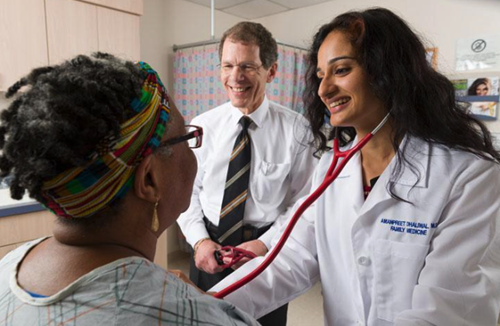
 Our curriculum is designed to teach residents how to practice in a Patient-Centered Medical Home. The Family Medicine Center functions as the centerpiece for the curriculum and has been recognized as an NCQA Patient-Centered Medical Home. During the course of the three years, residents spend an increasing amount of time in the FMC.
Longitudinal Family Medicine
The Longitudinal Family Medicine Curriculum offers teaching in practice management, evidence based medicine, performance improvement, advanced interviewing skills, team leadership skills, and stress management/personal wellness skills. Additionally, residents are taught how to conduct group medical visits for prenatal patients as part of our Centering program. The Longitudinal Family Medicine Curriculum also covers Dermatology, Medical and Surgical Subspecialties as well as experiences in Community Medicine, Alternative and Complementary Medicine, and Psychiatry/Addiction Medicine. All residents receive training in our Osteopathic Manipulative Treatment (OMT) Clinic, as well as training with point-of-care ultrasound technology.
Research
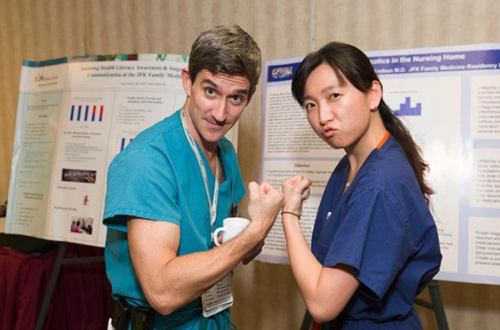
 During the first year, residents choose an area of interest, develop a research question, and write a research proposal. In the second year, residents refine their proposals, complete their projects, and present them to the residency. Residents also have an opportunity to share their research at Hackensack Meridian’s GME Research Day, the New Jersey Academy of Family Physicians Annual Meeting and the Rutgers Network of Family Medicine Residencies Research Symposium. Second and third year residents participate in an Academic Inquiry that combines a traditional Journal Club with an Evidence Based Medicine discussion of an interesting case presentation.
Osteopathic Curriculum
The JFK Family Medicine Residency Program received initial Osteopathic Recognition from the Accreditation Council for Graduate Medical Education in 2024. The Osteopathic curriculum will offer our residents and faculty longitudinal education of the osteopathic principles and practice.
The Osteopathic curriculum includes:
- Participation in OMT clinic monthly
- Ability to integrate osteopathic principles and practice during all clinical activities
- Osteopathic core lectures, workshops, and teaching during our weekly educational seminars as well as cases during morning report
- Osteopathic journal club
- 4 DO faculty preceptors available during all clinical activities
- Participation in osteopathic grand rounds
- Option to participate in OMT elective
- Develop osteopathic related QI/research projects
- Opportunity to teach OPP and OMT to medical students and co-residents in various clinical settings
Conferences
A lively aspect of residency education at JFK is our weekly lecture series. One afternoon per week, residents are excused from their rotations to attend lectures and workshops in the Family Medicine Center. Lectures cover common inpatient and outpatient problems and include behavioral science, research, practice management, evidence based medicine, and procedure workshops. Speakers are drawn from the Family Medicine faculty, the broad range of subspecialists on JFK’s Medical Staff, and visiting subspecialists. Included in the afternoon seminars is a unique series of behavioral science conferences including topics such as Motivational Interviewing, Physician Wellness, Working with LGBTQ+ patients, and Personality Disorders. Primary care research skills are also taught during the seminar series.
Daily morning report focuses on brief clinical/didactic presentations, continuity of patient care, and the transition of patient care.