

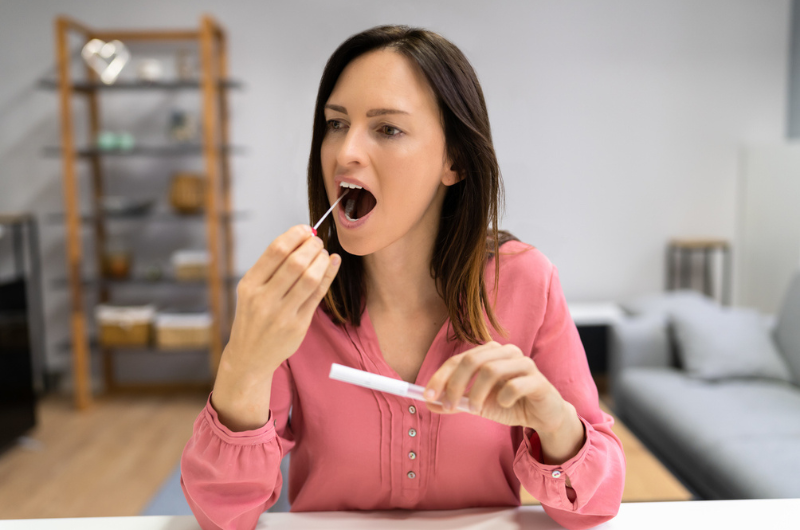
You’ve probably seen them advertised on social media or stocked on the shelves of your local pharmacy – at-home hormone tests promising insight into everything from fertility to menopause to overall hormone health. The appeal is obvious: you can learn about your body without leaving the comfort of your home. But are these tests reliable enough to guide your health decisions?
To help us separate fact from hype, we turned to Jocelyn A. Carlo, M.D., director of gynecology at Jersey Shore University Medical Center, who specializes in helping women understand and manage their hormonal health.
How At-Home Hormone Tests Work
Most at-home kits require a simple urine sample, saliva swab or finger-prick blood sample that you mail to a lab for analysis. Once processed, results are typically shared online, sometimes with a clinician available to help interpret them.
Checking Hormone Imbalance at Home: The Pros and Cons
Con: You’ll Likely Pay Out of Pocket
Will insurance cover hormone testing?
Most of the time, these tests are not covered by insurance, and at-home hormone kits can be pricey – often costing anywhere from $100 to several hundred dollars. That means the expense will likely come out of your own pocket.
Some people may be able to use a health savings account (HSA) or flexible spending account (FSA) to pay for the kit, but this isn’t guaranteed. Coverage depends on the test itself and your HSA/FSA administrator’s rules. It’s a good idea to check your HSA/FSA administrator’s rules before you buy so you know whether you’ll be reimbursed.
Pro: Hormone Tests are Convenient and Accessible
The main draw of at-home hormone test kits is ease of use.
“The advantages are centered on convenience and accessibility,” says Dr. Carlo. For women who don’t have easy access to a healthcare provider or live far away from medical centers, these kits may offer a helpful first step.
Con: Results Can Be Misleading
Are at-home hormone tests accurate? The answer is complex because hormones don’t stay constant – they fluctuate throughout the day and during different stages of the menstrual cycle.
“Hormone levels are transient,” explains Dr. Carlo. “For a lay woman, there is potential for misinterpretation of results, and with a mail-in system, reliability is in question as samples can be contaminated or otherwise not ideal for accurate testing.”
Pro: Hormone Tests Can Spark Helpful Conversations
At-home tests sometimes reveal useful clues about conditions such as menopause, thyroid disease or diabetes. For some women, having results in hand can make it easier to start a conversation with their doctor and ask for the right follow-up tests.
Con: They Only Show a Snapshot
At-home hormone test kits don’t paint a full picture of your health.
“They only provide a small snapshot of the person’s health,” says Dr. Carlo. Without professional context, it’s easy to miss the bigger story behind your symptoms.
Pro: They May Be Useful if Medical Care Isn’t Accessible
If seeing a doctor isn’t an option due to cost, distance or other barriers, at-home tests can at least provide some information. But Dr. Carlo emphasizes that this should be the exception, not the rule.
Con: They’re No Substitute for a Doctor’s Care
At the end of the day, only a health care provider can order the right labs, interpret results under medical guidelines, and create a plan that fits your unique situation.
“Ideally, women regularly visit their primary care physician and gynecologist for medical care,” says Dr. Carlo.
Key Takeaways on At-Home Hormone Tests
If you’re curious about at-home hormone testing, here’s what to keep in mind:
- Kits are convenient and may give useful clues, especially when access to care is limited.
- Results are often incomplete or inaccurate due to fluctuating hormone levels and sample issues.
- They can be a starting point but should not replace professional diagnosis and treatment.
If you’re worried your hormones may be “off,” consider using an at-home test only as a conversation starter. The best next step is always to share your symptoms (and any test results) with a trusted health care provider who can guide you toward real answers and relief.
Next Steps & Resources
- Meet our experts: Jocelyn Carlo, M.D.
- To make an appointment online with an OB-GYN near you, or call 800-822-8905.
- Learn more about our women’s health services.
Find a doctor near me

Surprising Ways Menopause Can Impact Heart Health
Menopause & Heart Health: Learn how menopause impacts your heart from Drs. Sahni & Vandyck-Acquah. Protect your heart health. Schedule an appointment today.
Fibroids After Menopause: What to Do When Symptoms Won’t Let Up
Declining estrogen levels typically shrink uterine fibroids. But our expert explains why those approaching menopause may be hit with new symptoms.
How to Know if Your Hormones are Out of Balance
Feeling off? From fatigue to brain fog and irregular cycles, learn the signs of hormone imbalance and when it’s time to talk to your doctor.