Getting Back to Life After Spinal Cord Injury
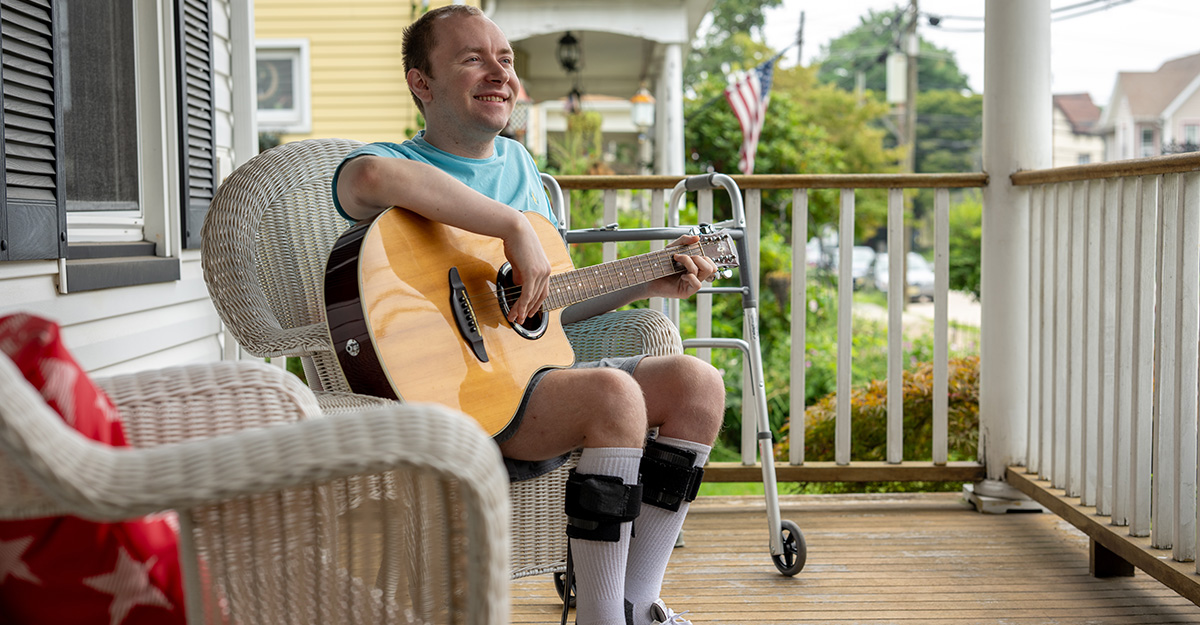
Jack Mehr sits on his porch in Milltown, New Jersey, confidently strumming his guitar. Only the braces around his legs and the nearby walker hint at the event that changed his life. A graduate of the University of Virginia, where he studied psychology and philosophy, Mehr spent time as a professional poker player — a “unique way to spend my 20s,” as he puts it — living in Las Vegas and Philadelphia.
In March 2023, during an unprecedented manic episode, Jack attempted suicide by jumping from his Philadelphia apartment building. He was rushed to Temple University Hospital with an aortic rupture, often fatal, and multiple traumatic injuries.
After three months in the ICU and three more at a skilled nursing facility, Mehr, still in a cast, catheter, and wheelchair, was told he was “done with therapy,” recalls his mother, Christina “Trina” Mehr, a former Milltown mayor who works in the pharmaceutical industry. “I thought, ‘How could that be?’” The family later learned about the Spinal Cord Injury Program at JFK Johnson Rehabilitation Institute.
In the fall of 2023, Mehr began intensive inpatient therapy at JFK Johnson. He was the first patient to stay in the new Eric LeGrand Spinal Cord Injury Patient Care Room, funded by a $250,000 gift from Rutgers Football Coach Greg Schiano and his wife, Christy. The room is named after the Rutgers football player who sustained a spinal cord injury during a game.
Two weeks of intensive inpatient rehabilitation and daily care, led by Dr. Jennifer Chui and including support from a rehabilitation psychologist, set Mehr on a new path. He went from relying on a wheelchair to walking at home with a cane and in the community with a walker and leg braces. Soon he will learn to drive with hand controls.
Mehr calls his care team “life-changing,” especially Jennifer Chui, MD, who diagnosed his spinal cord injury. “After arriving at JFK Johnson, I started to believe I could live independently again. The team always knew just how hard to push me,” he says.His mother remembers, “Jack couldn’t get in and out of the car when we brought him to JFK Johnson. Two weeks later, he could do it alone. His outcome has exceeded our hopes. We are so grateful.”
Today, with a walker, Mehr navigates the eight steps from the porch to the sidewalk and walks along the street. Recovery has been emotional, too. Diagnosed and now treated for bipolar disorder, he works to protect both his physical and mental health. “I had to work through the grief over my suicide attempt while also working to recover from my injuries,” he says. Today Mehr volunteers at a suicide hotline and plans to return to school for an advanced degree in clinical mental health counseling.
The family is open about the cause of his injuries. “Everyone knows someone who is struggling,” his mother says. “We knew Jack had depression, but not mania. This came out of the blue. It’s been an up-and-down road, but there is hope. We are glad we came home to New Jersey for his treatment.”
The CDC estimates that more than one million Americans survive suicide attempts each year, many with lasting disabilities. Today Mehr says he looks forward to his future and the ability to help others struggling with mental health conditions.
“I never thought I could be a mental health practitioner,” he says. “Now I believe I can be there for people struggling with mental illness. My journey has made me want to be in a field that focuses on healing.”
Learn more about our innovations in rehabilitation care.
If you are a patient looking for expert rehabilitation care at Hackensack Meridian Health, please visit our rehabilitation services page to learn about our specialties, find locations, and schedule appointments.