
Independence After a Rare Spinal Cord Injury
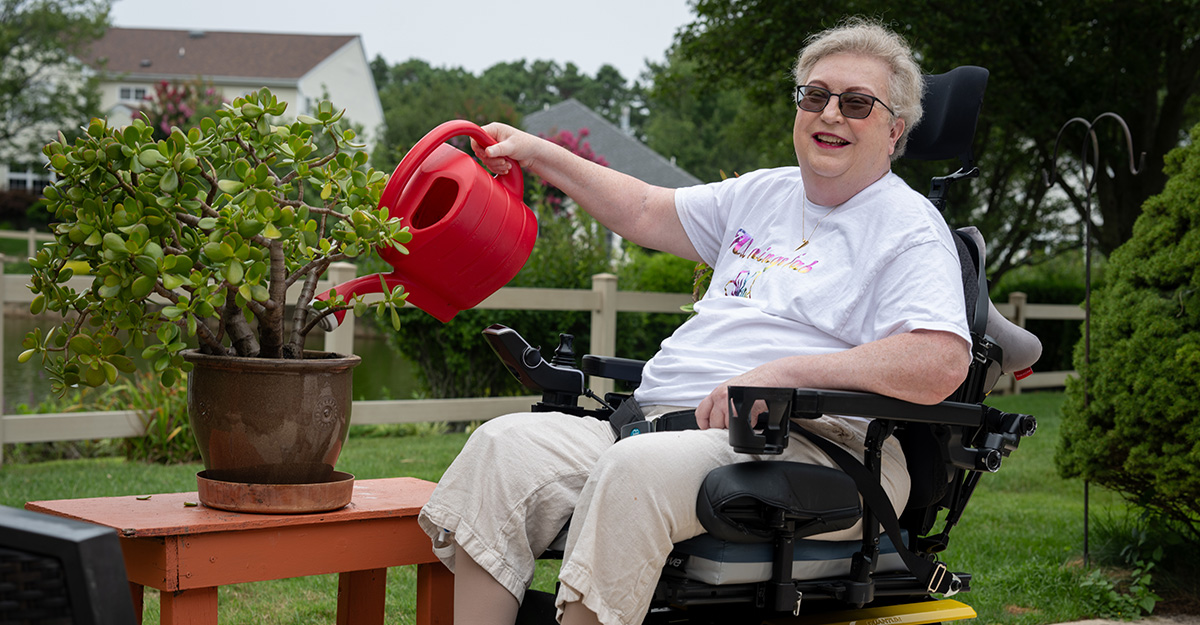
Ann Dey had just entered her early 60s and recently retired when her life changed in an instant. She had lived for years with a rare, unknown congenital condition that causes arteriovenous fistulas, which are abnormal connections between blood vessels in her spinal cord. One day, while being treated at Jersey Shore Medical Center for something unrelated, she woke up paralyzed. Further workup revealed the rupture of the spinal cord fistula, and she underwent an emergency embolization.
Doctors classified her as a tetraplegic. At that point, all she could move was her big toe.
“Waking up like that was terrifying. My brain was in shock, and I couldn’t even process what had happened,” Dey recalls. Once medically stable, she was transferred to JFK Johnson Rehabilitation Institute, where she came under the care of Jennifer Chui, MD, a specialist in spinal cord injury at the Spinal Cord Injury Program.
“I did physical therapy twice a day, about six days a week,” Dey says. “At first, sitting up … I felt like being Humpty Dumpty — I just toppled right over. But week by week, I saw improvement.”
An Independent Life
Encouraged by a dedicated team, Dey regained strength and motor control. Before she left JFK Johnson in-patient care, she was able to stand. She walked between parallel bars. Her progress continued and in outpatient rehabilitation recently she walked 169 feet with a walker.
Once discharged from the inpatient program, she continued with JFK Johnson Spinal Cord Injury outpatient therapy program and her progress continued.
“Now I can go from the wheelchair to standing up in the walker. And the biggest challenge right now is to make sure I'm using my knees to pull me up versus just my arms,” Dey explains.
She says JFK Johnson provided the foundation for her to build upon. “Without the JFK Johnson team, I really think I probably would have ended up in a nursing home or some kind of facility — now I look forward to life,” she says.
At her new home in Lakewood, New Jersey, Dey continues to push forward. She lives in a one-floor home designed for accessibility, where she uses a wheelchair. Early in her recovery, she recalls the challenges of trying to feed herself. It took forever, it seemed, to open a carton of milk. “If you don’t try, it won’t happen,” Dr. Chui reminded her, she recalls. Dey carried that mindset throughout her recovery.
Looking toward the Future
Her resilience is rooted in a career of service. With a PhD in community psychology, Dey worked in HIV prevention and social services, leading statewide initiatives in Kansas, Missouri, and New Jersey. She specialized in focus groups, listening to people’s stories to shape effective public health programs.
Now, she feels called to share her own story. “Unless you’ve met someone in a wheelchair, you don’t think about accessibility. You don’t realize what ‘handicapped accessible’ really means to someone else,” she says.
She is grateful for the improvements she has made in her abilities to function. A movie buff, she recalls her first foray to a movie theater in her wheelchair: “I was able to get into a theater. I bought my own popcorn. I watched the show, and nobody had to help me. That’s when I saw the world opening up for me again.”
Learn more about our innovations in rehabilitation care.
If you are a patient looking for expert rehabilitation care at Hackensack Meridian Health, please visit our rehabilitation services page to learn about our specialties, find locations, and schedule appointments.