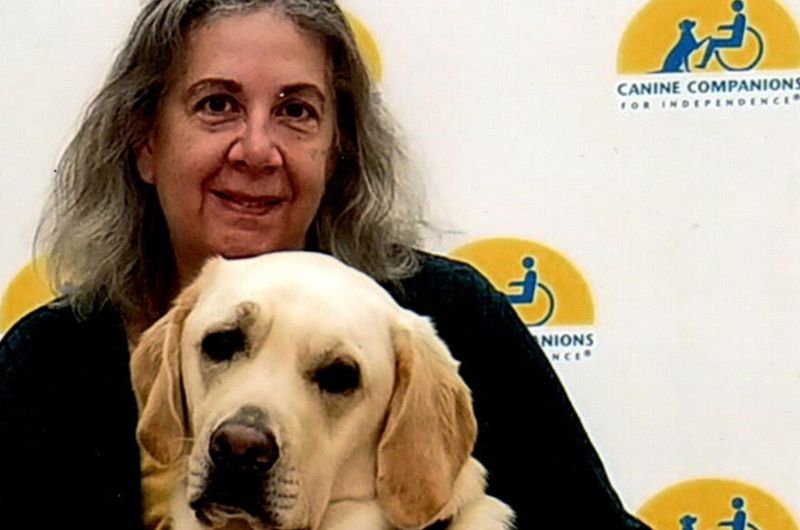
Cape Cod resident Dawn Laughlin is used to dealing with health challenges. She has Ehlers-Danlos Syndrome (EDS), a connective tissue disorder that causes joint pain, fatigue and heart issues. But in 2018, she began to have trouble breathing, which was a new symptom.
“At first, I noticed that I had trouble breathing when I bent over, and then it got to the point where I couldn’t walk and talk. When it was really cold, I struggled to breathe. I figured it was just another symptom of EDS,” she says.
But, during imaging tests for another health issue, radiologists noticed that Dawn had a paralyzed right diaphragm. Testing revealed that the issue was caused by damage to her right phrenic nerve. The phrenic nerve originates from the cervical spine and controls the diaphragm, a muscle essential for breathing.
Although there is a surgery to repair the phrenic nerve, doctors were hesitant to operate on Dawn because of her other health issues. “I was so frustrated. Breathing isn’t optional, I knew I would have to do something,” she says.
A Solution in New Jersey
Over the years, Dawn says her breathing continued to worsen and impacted her daily life. “I had trouble doing simple things and couldn’t even walk the dog anymore,” she says.
Through her research, she came across Matthew Kaufman, M.D., plastic and reconstructive surgeon and otolaryngologist at the Center for Treatment of Paralysis and Reconstructive Nerve Surgery at Jersey Shore University Medical Center. Dr. Kaufman has pioneered treatments for diaphragm paralysis due to phrenic nerve injury, and has successfully treated over 850 patients throughout the U.S. and from countries as far away as South Africa, Australia and Israel.
Because Dawn lives in Massachusetts, she sent Dr. Kaufman the results of previous imaging and breathing studies. However, there were a few studies she traveled to New Jersey to complete - phrenic nerve conduction testing and electromyography (EMG) testing of the diaphragm. These specialized tests measure the activity in the nerve and muscle to determine whether reconstruction was still appropriate.
“Electrical testing of the phrenic nerve and diaphragm is not routinely performed, even at many top institutions. As part of our Internationally Accredited center for diaphragm paralysis treatment, we have the ability to perform precise electrical testing to help determine the best treatment approach,” says Dr. Kaufman.
After reviewing her studies, tests and speaking with her physicians, Dr. Kaufman determined that Dawn would be a candidate for phrenic nerve reconstruction.
“I was so excited to think that I could just get my quality of life back,” says Dawn.
Phrenic Nerve Reconstruction
Dawn’s surgery took about three hours. During the procedure, Dr. Kaufman made a small incision near her clavicle to access the phrenic nerve. The first part of the surgery is called “nerve decompression”, whereby the phrenic nerve is explored, and scar tissue is removed. During the second part of the surgery, a small nerve graft is removed from the ankle and used to “bypass” the area of the phrenic nerve that was found to be damaged.
“By repairing the phrenic nerve and adding a nerve bypass graft, it is analogous to clearing the highway and adding a local road. We want as many pathways as possible to restore electrical activity to the diaphragm. This will allow her to rehabilitate the muscle and breathe normally,” says Dr. Kaufman.
Following the surgery, Dawn stayed one night in the hospital. However, since she lived so far away, Dr. Kaufman asked her to stay locally for five days to ensure she recovered fully before traveling home.
Within days, Dawn reported noticing a difference in her breathing. “It was amazing how quickly I was able to breathe normally again. I felt like a different person,” she says.
Breathing Easy and Living Life to the Fullest
After her surgery, Dawn did breathing exercises to regain full function of her diaphragm. She also resumed walking and other activities she had put off because she was unable to breathe properly. After just a few short months, Dawn was well enough to travel to Ireland.
She credits Dr. Kaufman with helping her enjoy life again.
“He was amazing, and his bedside manner was great. My only regret is that I didn’t find him sooner,” she says.
Dawn also encourages others to advocate for themselves when it comes to their health.
“I had a lot of doctors tell me nothing was wrong. The one thing I always tell people is to stand up for themselves. You know your body and when something isn’t right. You just need a doctor who believes in you,” she says.
Next Steps & Resources
- Meet our expert: Matthew Kaufman, M.D.
- To make an appointment with Dr. Kaufman, call 800-822-8905 or find a plastic surgeon near you.
- Learn more about our plastic surgery services.
Breathing Again After Spinal Cord Injury
Surgical Intervention Helps Man Breathe Easier After Accident

A Paralyzed Diaphragm Couldn’t Stop This Marathon Runner