
Chances are, you’ve heard of body mass index, or BMI. For a long time, it was considered a decent estimation for whether people were at a healthy weight. But that’s been called into question more recently.
The quick screening tool uses height and weight to see if you are overweight or underweight. Health care professionals often use it as a starting point — but not a diagnosis. It’s also one of the measurements doctors consider when discussing treatment options like GLP-1 weight-loss medications or bariatric surgery.
To cut through the confusion about when BMI helps and when it falls short, we sat down with Seth Kipnis, M.D., a general surgeon and medical director of bariatrics and robotic surgery at Jersey Shore University Medical Center, for a straight-talk Q&A.
Q: How is BMI Calculated?
A: BMI is calculated using a person’s height and weight with this formula:
BMI = (weight in pounds ÷ height in inches²) × 703
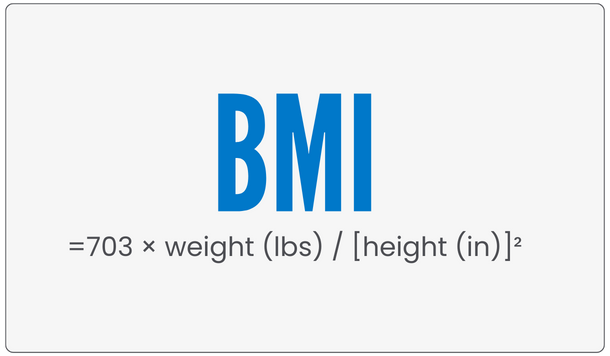
To find yours, you divide your weight by your height (in inches) times two; then multiply that number by 703.
You can view a BMI category chart to see how these calculated numbers are interpreted here.
Q: What are the Benefits of Using BMI?
A: It’s easy to measure and is standardized. It’s just height and weight. Nothing else.
Q: What are the Flaws of BMI?
A: BMI only looks at height and weight — it doesn’t consider things like muscle, bone density, age or where a person carries their weight. It was originally created almost 200 years ago as a way to study large groups of people, not to diagnose the health of individuals, which is why it doesn’t always tell the full story.
For example, think about a college football lineman who trains hard and has a lot of muscle. Because muscle weighs more than fat, his BMI may classify him as overweight or obese, even though he may be in excellent physical shape.
BMI can also be misleading across different racial and ethnic groups. Research has shown that populations of Asian and African descent often carry weight differently, have different body fat percentages at the same BMI, and may develop health risks at lower or higher BMI cutoffs than white populations. This means two people with the same BMI number may not have the same level of health risk.
Family history matters, too. If all the men in a family developed heart disease in their 50s, their doctors might approach weight and health risks differently — even if their BMI looks “normal.”
Q: Can You Be Healthy Even if Your BMI is High?
A: Yes. BMI doesn’t distinguish muscle from fat — two people can weigh the same, but a muscular person is usually healthier than someone with more body fat. BMI also rises with age as metabolism slows. For a 50-year-old, 25–29 can be perfectly healthy, even if the same BMI in a 30-year-old might signal extra fat. Age and body composition matter more than the number alone.
Q: If BMI Has Limitations, Why Do Insurers Still Use It?
A: Insurers still use BMI because it gives them a quick, standard way to decide who may qualify for treatments like weight-loss surgery. It’s not perfect, but it’s easy to measure and has been built into most medical and insurance guidelines. For weight-loss surgery, the idea is that at higher BMI levels, the long-term health risks are usually greater than the risks of the procedure — that’s why there are cutoff numbers in place.
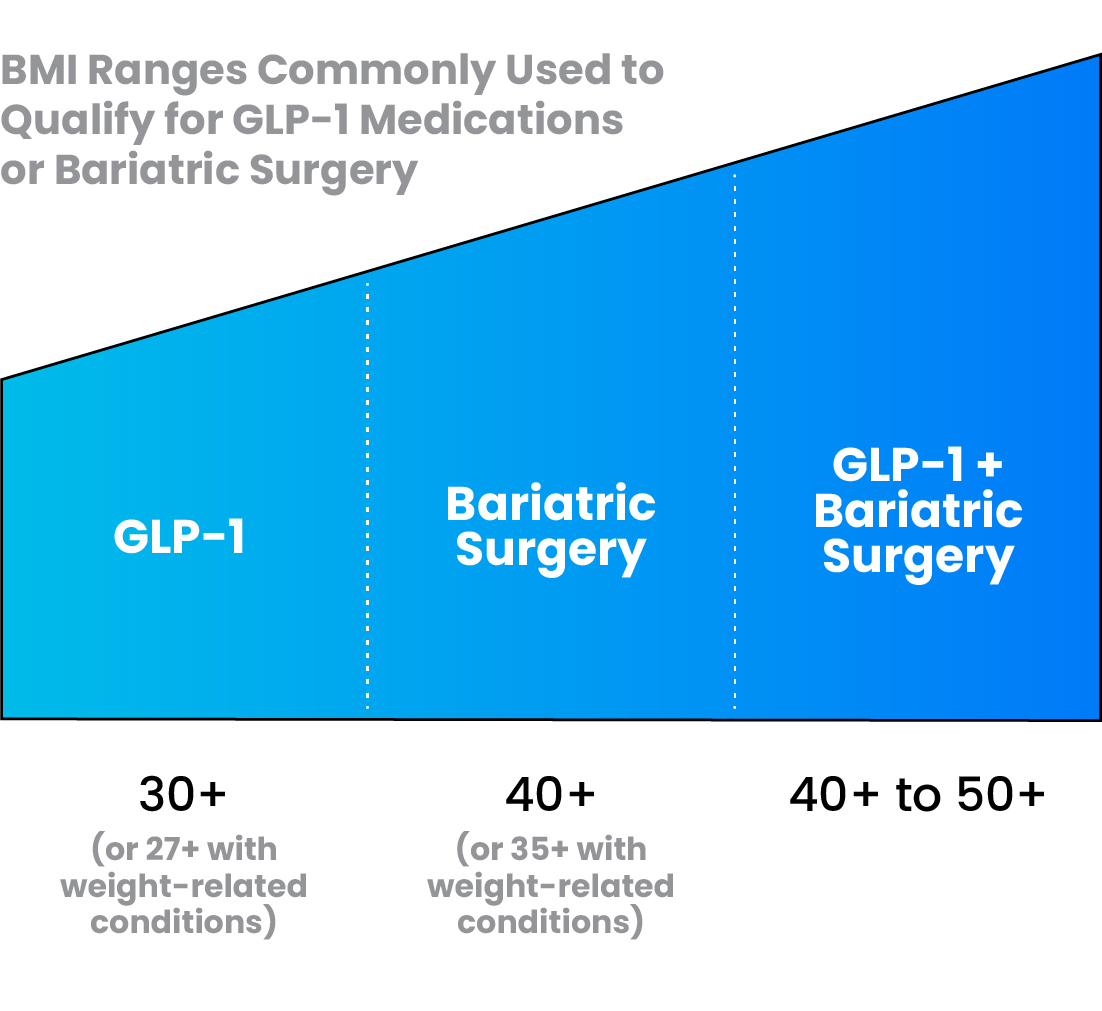
Q: What BMI Ranges are Commonly Used to Qualify for GLP-1 Medications or Bariatric Surgery?
A: GLP-1 medications are typically offered to people with a BMI over 30, or over 27 if you have weight-related conditions. Bariatric surgery is usually considered at BMI ≥40, or ≥35 with weight-related conditions. For very high BMIs (40–50+), medicines alone often aren’t enough, which is why some weight-loss programs combine approaches. Your care team should also look at overall health, goals and insurance criteria.
Q: After Weight-Loss Treatment, Should I Chase a Specific BMI Number?
A: Focus on “happy and healthy,” not just the number. Signs of success include:
- Fewer medications
- Better sleep, blood pressure and cholesterol
- More stamina and less body fat
- Feeling good in your clothes
Your provider will help set personal goals that make sense for your age, health history and lifestyle.
Q: Are There Better Ways to Measure Health Than BMI?
A: BMI is a rough guide – it doesn’t account for age, gender, body composition or fitness. Focusing only on BMI can miss important aspects of health. A better approach considers multiple factors:
- Waist circumference (for men) or hip circumference (for women)
- Body fat composition
- Stamina and exercise tolerance (e.g., Can you climb stairs without getting winded?)
- Age, gender, race, genetics, height and weight
Using a combination of these factors gives a clearer picture of health than BMI alone. In the future, simple apps or calculators that include these variables could help doctors set realistic goals and better track progress.
Next Steps & Resources
- Meet our source: Seth Kipnis, M.D.
- Make an appointment online with a weight management specialist or call 800-822-8905.
- Learn more about weight management at Hackensack Meridian Health.
Find a doctor near me

Top 3 Myths About Weight-Loss Surgery—Debunked!

6 Things You Need to Stop Doing After Weight-loss Surgery