

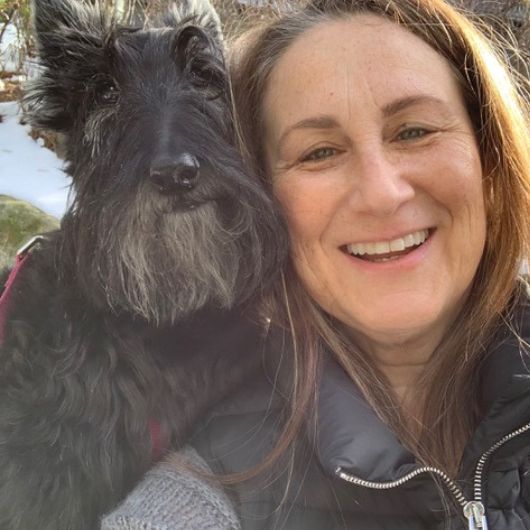
December 2020 was a stressful time for many people, but 56-year-old Debbie Naroff Scott was particularly overwhelmed. In addition to navigating the pandemic, she was completing her graduate studies, working an internship, and looking after her elderly parents in Florida.
When she felt searing pain in the back of her head and neck during her internship while working from home one morning, she initially wondered if it was anxiety. However, Debbie quickly realized she didn’t have a tension headache.
“The pain was unlike anything I had ever experienced. It was like a lightning bolt that went across my back and up my neck to my head, through me. Afterwards, I was nauseous and wasn’t sure I could move,” she says.
Debbie rested for a few hours, but couldn’t find relief. She called her internist at Hackensack, Dr. Sarita Rastogi, who urged her to go to the emergency room.
A Life-changing Diagnosis
Due to COVID-19 protocols, Debbie went to her local hospital alone, while her husband waited in the parking lot. She hoped she would be in and out quickly, but her hopes were dashed after a Computed Tomography (CT) scan showed a brain bleed.
“I could feel a shift in everyone’s mood right away. The doctor told me I would need to be transferred by ICU ambulance or helicopter to Hackensack University Medical Center so I could receive more advanced care,” she says.
Debbie’s brain bleed was a subarachnoid hemorrhage, a type of stroke that happens when blood leaks into the space between the brain and the membrane covering it. Subarachnoid hemorrhages are often life-threatening. While some can be treated successfully, others may be fatal even with prompt medical care. Stunned, they allowed Debbie’s husband to come in and say goodbye to her before she was transported to Hackensack.
Managing a Fragile Situation
Debbie was taken to The Stroke Center at Hackensack University Medical Center. As a designated comprehensive stroke center, the stroke team at Hackensack is equipped to treat the most complex stroke cases.
Much of Debbie’s early days in the ICU were filled with tests and imaging studies to make sure the bleeding stopped and she didn’t suffer complications. Dr. Walzman tried to pinpoint the cause of Debbie’s brain bleed by doing an angiogram.
“A ruptured aneurysm, a weak spot in the wall of a blood vessel in the brain, usually causes a subarachnoid hemorrhage, but Debbie’s case was unique because she didn’t have an aneurysm or any obvious trauma. The good news is that the chance of her suffering another brain bleed is low,” says chief of Vascular and Endovascular Neurosurgery at Hackensack Meridian Neuroscience Institute at Hackensack University Medical Center, Daniel Ezra Walzman, M.D.
For two weeks following her brain bleed, Debbie was at an increased risk for certain complications. To monitor her progress and prevent complications, Debbie had a Doppler ultrasound every morning. The Doppler showed how well blood was flowing through her veins and ensured she didn’t have additional bleeding in her brain. She also had frequent imaging studies.
When Your Care Team Becomes Family
Watch Video: Severe Headache Sends Her to the ICU!
Although Debbie says she doesn’t remember much about her early days in the ICU, she knows she felt safe. “I wasn’t able to have family in the hospital because of COVID-19, so I was lonely and scared - at times panicked. I remember the first time I met my ICU night nurse, Christina, when I was transferred to the trauma ICU four days into my stay. She was reassuring and kind. I felt an immediate soul-like connection with her,” says Debbie.
The feeling was mutual. Christina says she instantly felt a connection with Debbie. “She was one of those patients I was always happy to see,” says Christina.
Debbie also looked forward to seeing Dr. Walzman. “He was always so kind. I think I asked him every day when I could go home. He was patient and took the time to explain what was happening,” adds Debbie. He was soft yet firm in his insistence that I not go home until he thought I was safe.
After ten days of observation and tests, Dr. Walzman felt Debbie was out of the woods and released her from the hospital. She made it home for the last night of Hanukkah. “It was surreal to step out of the hospital and go home, but I knew my recovery was just beginning,” she says.
Healing by Helping Others
Debbie says her recovery was initially difficult. “I had severe burning headaches and lived in fear that it was going to happen again every time I got a headache,” she says.
Debbie also had to learn to prioritize herself. Her internest, Sarita Rastogi, M.D., drove the point home: “I don’t care what’s going on around you—you are the most important.” That simple statement shifted Debbie’s entire approach to recovery.
“My doctors warned me that stress and anxiety could make my headaches and other symptoms worse. I had to do something I had trouble doing before, put myself first.”
As part of her recovery, Debbie joined a support group. She found the support of others who had experienced a similar situation and found writing about her journey to be therapeutic. She has published articles about her experience that she hopes will help others learn the warning signs of strokes.
One thing she tells people is not to ignore severe headaches. While she’s had headaches throughout her life, she says the one associated with her subarachnoid hemorrhage was debilitating and describes it as ‘the worst headache of her life’. She’s glad she listened to her gut and went to the hospital when she did.
“I want to help others realize that strokes can happen to anyone. It’s important to listen to your body. I was in seemingly good health. I was lucky to get to the hospital when I did and have such an amazing care team,” says Debbie.
Next Steps & Resources
- Meet our source: Daniel Ezra Walzman, MD
- Make an appointment online with a neurosurgeon near you, or call 800-822-8905.
- Learn more about our neuroscience services.

Food for Thought: The Mediterranean Diet and Brain Health
The classic Mediterranean diet deserves fresh consideration. Our dietitian says it’s diverse, doable and delicious — and science says it can boost your brain.
7 Ways to Strengthen Your Spine
Strengthen your spine with 7 expert tips. Learn how to improve posture, exercise safely, and maintain a healthy weight for better back health. Ocean Medical Center offers guidance.

Surprising Ways Meditation Benefits Your Brain and Body
Try meditation to benefit your mental and physical well-being and experience quality time with yourself.