
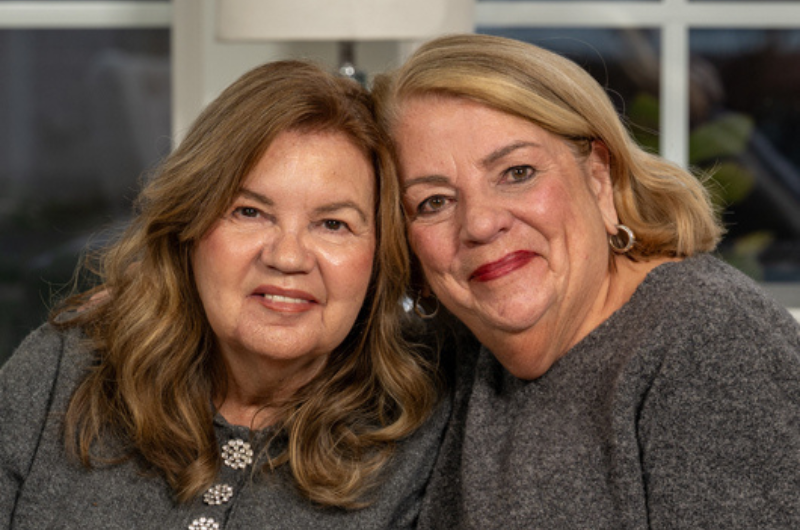
When a routine mammogram screening revealed a surprise breast cancer diagnosis, 67-year-old Diane Quirk of Jersey City, NJ, took a deep breath, got the facts and moved forward.
“I had no symptoms,” Diane says. “I went in May for my annual mammogram, and they saw something suspicious.” She went back for more tests — an MRI and ultrasound — and doctors found a tiny tumor in her right breast.
Early Detection With Annual Mammogram Screening
Diane’s sister had breast cancer decades ago, so Diane knew where to turn. She saw breast surgeon Debra Camal, M.D. at Riverview Medical Center.
Dr. Camal explains what the care team saw first. “On the mammogram, the breast radiologist saw calcium deposits—little white specks — which can be the earliest sign of a cancerous or pre-cancerous process,” she says. Further imaging found a very small mass, about a quarter of an inch wide. A needle biopsy confirmed breast cancer, and it looked favorable: detected early and very treatable.
Fast, Focused Surgery for Breast Cancer Treatment
From there, Diane’s breast cancer treatment moved quickly. Approximately one month after the first, suspicious mammogram, she had surgery — a lumpectomy and a sentinel lymph node biopsy to check whether the cancer had spread. It hadn’t. “They took two lymph nodes out and it did not spread anywhere,” she says.
For many women, lumpectomy is the preferred surgical approach. “About 75–80 percent of women with breast cancer are good candidates for breast conservation, also known as lumpectomy,” says Dr. Camal. “Interestingly, women who are eligible for lumpectomy have as good or better prognosis after lumpectomy than mastectomy because recovery is easier and removing the breasts does not generally reduce recurrence risk in most cases.”
Riverview’s surgical team also uses wire-free localization technology that lets doctors mark the location of the cancer in the breast before surgery. “It makes the whole surgical experience easier and less stressful,” Dr. Camal says.
Diane’s pathology brought more good news. Her Oncotype DX score — a genomic test that looks closely at the tumor cells — was 14, which is low. “That was proof she did not need chemotherapy,” Dr. Camal says. “In Diane’s case, everything lined up in a good direction. She had a small stage-one tumor with a favorable cell type and no sign of lymph node involvement. And her prognosis is outstanding because of early detection.”
Four Weeks of Radiation—and a Lot of Support
After surgery, Diane started radiation — once a day, five days a week—for four weeks. She chose to have radiation for breast cancer treatment at Riverview even though she lives in Jersey City. “I found Riverview Medical Center excellent,” she says. “Everybody there is very friendly. Dr. Camal is excellent — very calming.”
Radiation itself is short and simple. “It should be less than 30 minutes door to door,” Dr. Camal says. Each actual radiation treatment is probably about seven or eight minutes, and there is no pain or discomfort during the treatment. Some people notice pink skin or mild fatigue, but those effects fade.
“Her risk of recurrence should be well under 5 percent,” Dr. Camal adds, assuming Diane also starts a daily pill called an aromatase inhibitor, which helps prevent the cancer from coming back.
Dense Breast Tissue: Why Additional Screenings Matter
One challenge in Diane’s story is that she had dense breast tissue, which makes mammograms harder to read. “Trying to find cancer in a dense breast is like trying to find a snowball in a snowstorm,” Dr. Camal says. The good news: in New Jersey, insurance covers screening ultrasound for women with dense breasts, even without a lump. In Diane’s case, careful imaging — and a second look at her films by specialized breast radiologists — made a big difference.
Dr. Camal’s advice: “Get your mammograms,” she says. “And if you have dense breasts, ask about ultrasound.”
Next Steps and Resources
- Meet our source: Debra Camal, M.D.
- To make an appointment for a mammogram near you, call 800-822-8905 or visit our website.
- Learn more about women's health at Hackensack Meridian Health.

When to Have Surgery After Breast Cancer Diagnosis
When Should You Start Getting a Mammogram? Experts Say at 40

Are Cancerous Breast Lumps Painful?